
Regenerative Human Capital Coordination Meeting Highlights Prof. Rudolf Wirawan, Ph.D.’s BIMA Framework as a Bridge Between Science, Ethnoscience, and Ecological Consciousness
Cirebon, May 6, 2026 — An inspiring presentation on the BIMA (Bridging Intelligence, Mindfulness, and Awareness) Framework was delivered by Prof. Rudolf Wirawan, Ph.D. during the online coordination meeting titled Regenerative Human Capital: Co-Creating Ancestral Wisdom and Geo-Science for Youth-Led Disaster Resilience in West Java. The discussion brought together Lala Bumela Sudimantara, Ph.D. (UIN Siber Syekh Nurjati Cirebon), Assoc. Prof. Annisa Triyanti, Ph.D. (Utrecht University, Netherlands), Luqman Baehaqi, Ph.D. (UIN Palangka Raya), Wakhid Nashruddin, Ph.D. (UIN Siber Syekh Nurjati Cirebon) and several students from English Language Teaching Department of UIN Siber Syekh Nurjati Cirebon. The session explored the relationship between science, ethnoscience, and ecological awareness in shaping a more balanced future. Participants from various academic backgrounds engaged deeply with the discussion, which challenged dominant ways of thinking about knowledge and development. From the beginning, the atmosphere of the forum felt reflective and thought-provoking. Rather than presenting knowledge as fixed and hierarchical, the session encouraged participants to see learning as circular, relational, and interconnected. This perspective created a meaningful foundation for broader discussions on sustainability and regenerative education.
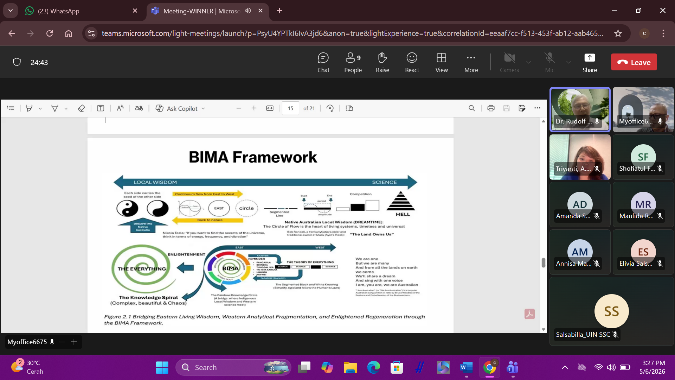
Opening his presentation, Prof. Rudolf Wirawan, Ph.D. explained that the BIMA Framework emerged from observing spiral patterns in nature, such as the movement of water and wind. According to him, these natural patterns reflect how life develops in circular movements while continuously evolving to higher levels. He argued that many traditional societies in the Global South naturally developed circular and collaborative systems of thinking. In contrast, modern hierarchical systems often encourage competition and inequality. This difference, he suggested, shapes how humans interact with one another and with the environment. Through this explanation, participants were invited to reconsider the assumptions underlying contemporary educational and social systems. The discussion positioned nature itself as a teacher that offers insight into more balanced ways of living.
As the presentation continued, Prof. Rudolf Wirawan, Ph.D. emphasized the importance of balancing science and ethnoscience rather than placing one above the other. He explained that ancestral communities have long interpreted natural phenomena and preserved ecological understanding through stories, rituals, and lived experience. However, modern society often dismisses these forms of knowledge because science is seen as more valid and objective. According to him, relying solely on scientific logic creates an incomplete understanding of reality. He stressed that ethnoscience contributes emotional, spiritual, and cultural dimensions that modern systems frequently overlook. As he explained, “We need both science and ethnoscience to create balance and collaboration.” This statement became a central message throughout the discussion.
To illustrate the consequences of imbalanced systems, Prof. Rudolf Wirawan, Ph.D. presented several examples related to environmental exploitation. He reflected on how society continues using plastic bottles despite knowing their harmful impact on the environment. The concept of recycling, according to him, often reflects a competitive mindset focused more on sustaining consumption than changing behavior itself. He also highlighted mining activities that continue because they generate economic profit despite causing environmental destruction. These examples demonstrated how modern systems frequently prioritize economic interests over ecological balance. Participants responded thoughtfully to these reflections because they connected directly with contemporary environmental realities. The discussion encouraged deeper awareness of how human actions shape ecological crises.
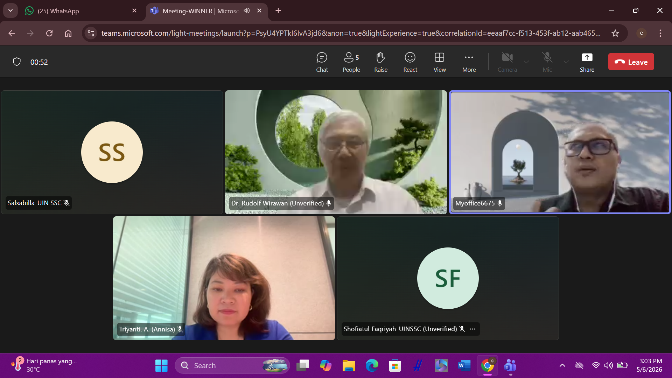
A particularly engaging part of the presentation emerged when Rudolf Wirawan shared the implementation of the BIMA Framework at Universitas Pahlawan Tuanku Tambusai. He introduced an innovation called Knowledge Tree, a sensor-based irrigation system personally developed by Prof. Rudolf Wirawan, Ph.D., and designed to “listen” to the soil before watering plants. Unlike timer-based systems, the tool activates only when the soil genuinely needs water. According to him, this approach reflects the essence of the BIMA Framework because technology is used to respond sensitively to nature rather than dominate it. The example showed how ecological awareness can be integrated into practical technological development. It also demonstrated that sustainability involves attentiveness, wisdom, and balance. Through this explanation, participants could see how theoretical concepts can be transformed into concrete action.
In the closing discussion, Rudolf Wirawan emphasized that the future of education and research should involve direct collaboration with communities. He encouraged students and researchers to engage in observation, surveys, and dialogue with local societies in order to understand real environmental needs. According to him, meaningful solutions emerge when modern knowledge systems work together with local wisdom. He also stressed that the BIMA Framework is not only a theory, but a practical approach to creating harmony between humans, technology, and nature. As he reflected, “The spiral concept teaches us to grow together rather than compete against each other.” This final statement captured the philosophical essence of the session. Ultimately, the presentation invited participants to imagine a future where sustainability is built through balance, awareness, and collective responsibility.
Author: Salsabilla