
Reimagining Education in the Age of AI: Prof. Andrew Lian Unveils ‘Alternative Intelligence’ at AsiaCALL 2025 Pre-Conference
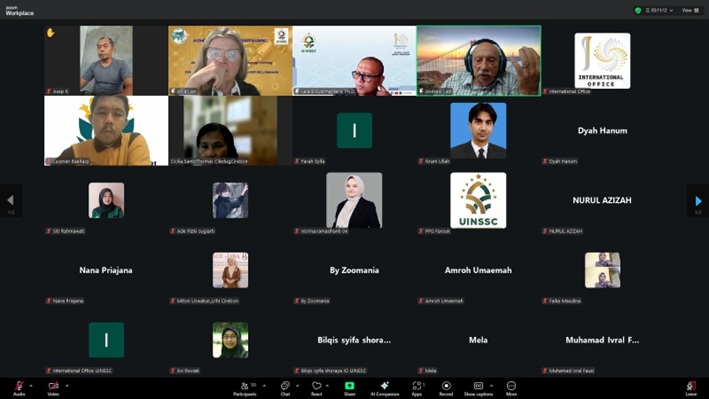
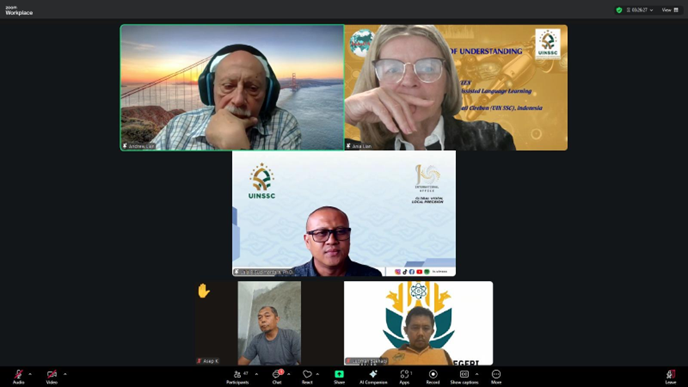
Cirebon, October 9 2025 — Lala Bumela Sudimantara, Ph.D., Director of the International Office of UIN Siber Syekh Nurjati Cirebon and Global Engagement Team (GET), successfully hosted the pre-conference workshop of AsiaCALL 2025, which took place online with an international audience. The event, titled “AI in Language Education: Between Innovation and Integrity,” featured Professor Andrew Lian, Ph.D. (President of AsiaCALL 2025) and Ania Lian, Ph.D. (Vice President of AsiaCALL 2025) as keynote speakers. The workshop attracted 55 participants from Indonesia, China, Vietnam, Nigeria, Thailand, and Australia, marking another milestone in UIN SSC’s growing global engagement. “In the late 1800s, drivers had to follow a man waving a red flag; in 2024, we surround large-language models with equally restrictive policies,” said Prof. Andrew Lian, comparing society’s fear of AI to early anxieties about new technology.
In his presentation, Prof. Andrew Lian introduced the idea of “Alternative Intelligence,” a concept that redefines how humans should perceive artificial intelligence in the modern era. He emphasized that AI should not be feared or treated as a threat but rather embraced as a collaborative partner that can enhance human thinking and creativity. According to him, this collaboration allows humans to extend their cognitive abilities through intelligent systems capable of processing vast amounts of information. These systems can scan billions of texts, identify complex patterns, and generate meaningful insights in a natural, conversational manner. Prof. Andrew Lian also shared an interesting experience when he asked ChatGPT to critique his own theory, which surprisingly offered him new perspectives and deeper understanding of his ideas.
Prof. Andrew Lian explained that “AI should not be seen as a separate brain,” but rather as a cognitive exoskeleton that expands and strengthens human capabilities in the process of thinking and learning. He described this cognitive partnership as a system that can scan billions of texts, detect unseen patterns, and communicate insights in an interactive and conversational manner. According to him, this integration between human and machine intelligence allows individuals to access deeper understanding and make connections that might otherwise remain hidden. By framing AI as an extension of cognition rather than a rival, Prof. Lian sought to reduce the fear often associated with artificial intelligence in education and research. Through this concept, he encouraged educators to view AI as a valuable collaborator that supports creativity, reflection, and the continuous expansion of human understanding.
In the continuation of his presentation, Prof. Andrew Lian emphasized how artificial intelligence is reshaping the way knowledge is produced, shared, and assessed in academic contexts. He argued that universities should begin to question the long-standing belief that all meaningful knowledge must originate solely from the learner’s mind. Instead, he urged educators to recognize that knowledge today often emerges from collaboration between human reasoning and intelligent systems. According to him, the use of external cognitive tools, such as citation managers, large-language models, and other AI-based systems should be seen as a natural extension of human intellect. By integrating these tools into the learning process, educators can foster more critical, creative, and reflective forms of learning that better prepare students for the challenges of the modern world.
Furthermore, Prof. Andrew Lian explained that this emerging paradigm serves as a bridge between quantitative and qualitative research, allowing the strengths of both approaches to complement each other in powerful ways. He emphasized that artificial intelligence makes it possible for educators and researchers to process vast numerical datasets while simultaneously interpreting rich qualitative materials such as interviews, reflections, and written works. Through this synthesis, AI enables what he terms “precision interventions” teaching approaches that can dynamically adjust to each learner’s specific needs and learning trajectory. According to him, such data-informed personalization holds immense potential for creating more responsive and inclusive educational environments. He added that these innovations could fundamentally transform classroom assessment practices, making feedback more individualized, meaningful, and effective in promoting deeper learning.
In the closing discussion, one participant voiced a concern that algorithmic feedback might risk dehumanizing the learning process by replacing empathy with automated responses. Responding thoughtfully, Prof. Andrew Lian clarified that the value of a machine should not be measured by its capacity for emotion, but by its ability to extend human potential beyond natural cognitive limits. He illustrated this point through a striking analogy, saying that a novel though not sentient can still profoundly reshape a reader’s inner world and emotional understanding. With this reasoning, he underscored that the essence of education lies not in the tool itself but in the purpose and framework guiding its use. He concluded by reminding the audience that “epistemology does not belong to AI; it belongs to the learning theory that frames AI’s use” meaning that if an educator values dialogic meaning-making, then AI should serve to open new spaces for dialogue, not to close them.
Author : Salsabilla