
Returning to Sacred Memory and Ecological Responsibility: Sukad’s Call to Restore Human–Nature Balance at the International Seminar and Workshops 2025
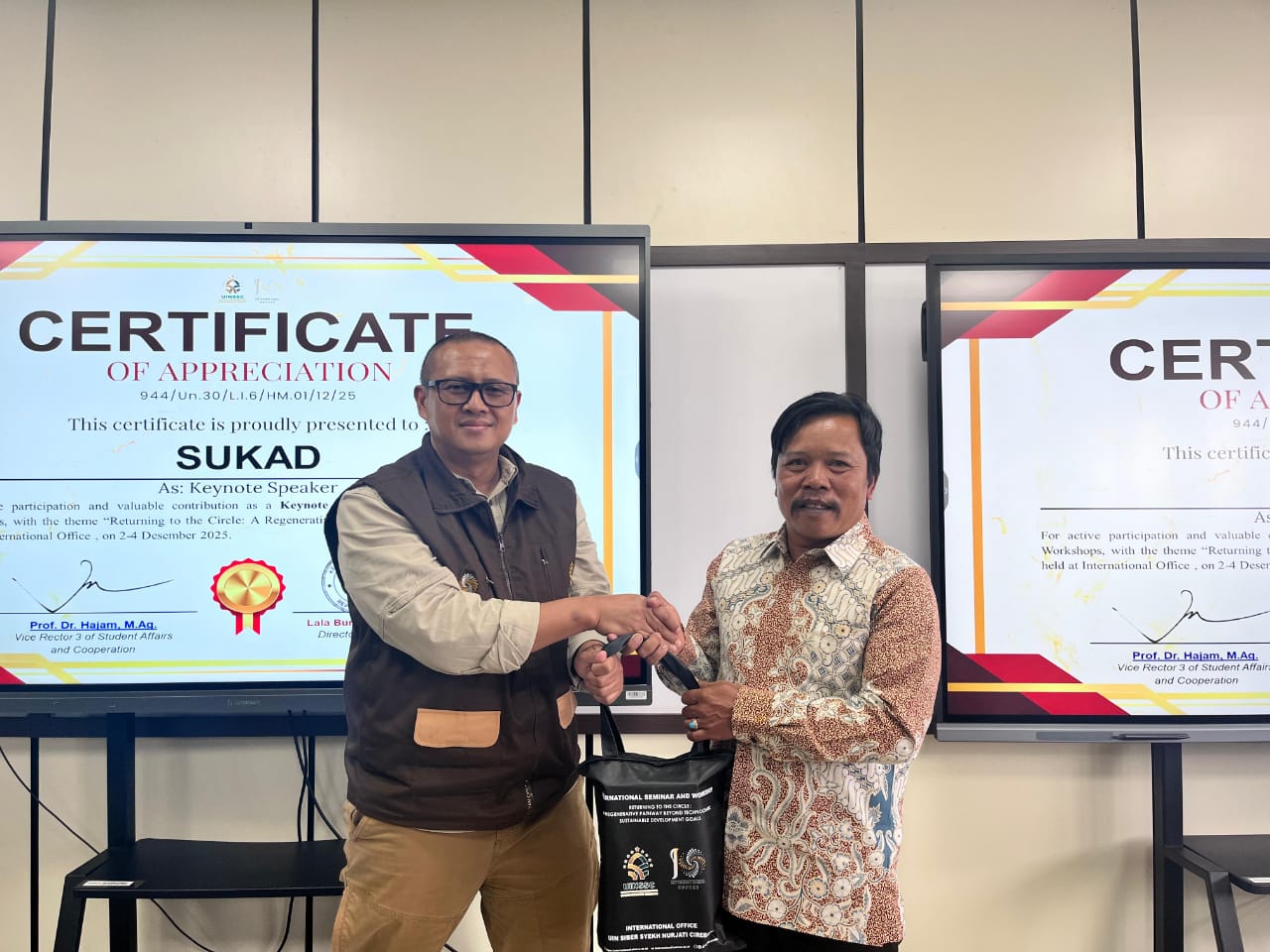
Cirebon, December 2, 2025 — The International Office of UIN Siber Syekh Nurjati Cirebon successfully held the International Seminar and Workshops 2025 under the theme “Returning to the Circle: A Regenerative Pathway Beyond Technocratic Sustainable Development Goals.” On the first day of the program, the second keynote session was delivered by Sukad, a spiritual elder and the guardian of the Sagarahiang, Kuningan, West Java. Held at the International Office on the 5th floor of the Siber Building, the event was attended by the Director of the International Office, Lala Bumela Sudimantara, Ph.D., the Global Engagement Team, representatives from Hakim Ventural International—Aries Endri Susanto, S.T., M.E. and Nur’aeni, S.E., M.E.—as well as keynote speaker Didin Misbahuddin, S.Hum., a researcher from the Niskala Institute Bandung. The session served as a continuation of Didin’s earlier presentation on carita pantun, a Sundanese oral tradition rich with cosmological and ecological teachings. Transitioning from this foundation, Sukad provided a deeper reflection on the interconnectedness between sacred narratives and the ethical responsibilities humans bear toward nature. His presence brought an atmosphere of ancestral wisdom that resonated strongly with both local and international participants.
In his presentation, Sukad highlighted how carita pantun is not merely a form of cultural expression but a guide for sustainable living that predates modern environmental frameworks. He emphasized that Didin’s explanation of pantun’s narrative structure mirrors the way indigenous communities construct their ecological ethics. Sukad then connected these narratives to the duty of protecting the environment, especially the sacred landscapes around Mount Ciremai. He stressed that embedded within pantun are instructions regarding which zones of the mountain must not be disturbed. As he stated, “If we preserve the pantun tradition and understand the ecological principles within it, then we can continue protecting nature, even in the absence of a pantun guardian.” This statement anchored his argument that cultural survival is inseparable from environmental stewardship. The audience welcomed this perspective as an alternative yet deeply grounded counterpoint to technocratic interpretations of sustainability.
Building on this conceptual bridge, Sukad explained that pantun traditionally functions both as paparan (oral exposition) and tuntunan (practical guidance). He argued that this dual function positions pantun as a regenerative framework in which knowledge is transmitted through speech and enacted through daily ecological conduct. By understanding pantun in this way, communities learn not only to remember their responsibilities but also to embody them. According to him, pantun is a living archive that encodes ethical behavior, territorial boundaries, and ecological restrictions. Such instructions are not theoretical abstractions but lived commitments, shaping how communities interact with land, water, and spiritual spaces. Sukad reiterated that losing pantun would mean losing a cultural compass that has guided environmental management for generations.
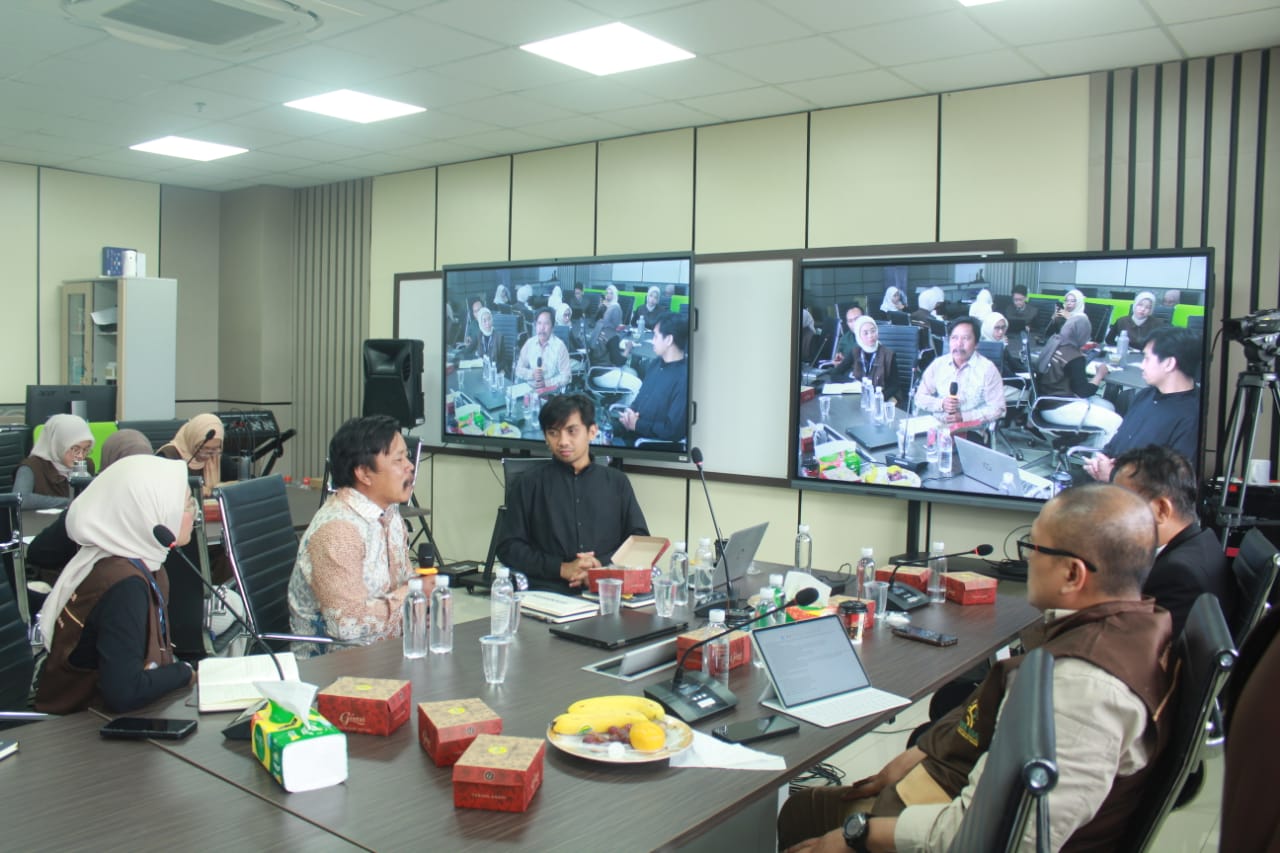
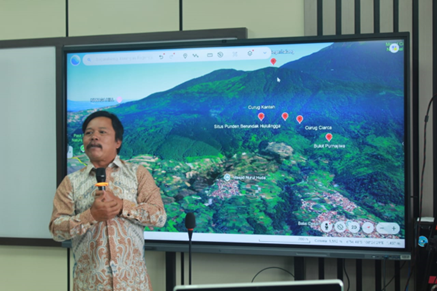
To provide a tangible illustration of the principles he discussed, Sukad introduced the audience to several key water sources on Mount Ciremai: Ibu Pertiwi, Seke Sadel, and Seke Menger. He described Ibu Pertiwi as the highest and most sacred spring, located near the summit, functioning as a barometer for the mountain’s overall ecological health. Beneath it lies Seke Sadel, followed by Seke Menger, forming a vertical chain of interconnected water flows crucial for surrounding communities. Sukad emphasized that the area around Ibu Pertiwi is an essential water catchment and thus must never be built upon or disturbed. He warned that damaging this zone would compromise the entire hydrological network of Ciremai, threatening not only the mountain ecosystem but also the urban and agricultural regions that depend on it. Participants noted how these explanations provided an ecological clarity rarely seen in urban planning discussions.
Further elaborating on the consequences of ecological disturbance, Sukad explained that if areas surrounding Mount Ciremai were ever disrupted, a severe clean-water crisis would likely emerge across Cirebon and Indramayu. Communities would then be forced to rely on river extraction followed by filtration, a process far less sustainable and far more costly than protecting the mountain’s springs. His explanation offered a stark reminder that environmental degradation does not occur in isolation but cascades through social, cultural, and economic systems. By linking traditional ecological knowledge with contemporary risks, Sukad demonstrated how indigenous perspectives can enrich modern environmental discourse. Many attendees expressed appreciation for the way he translated ancestral wisdom into concrete, policy-relevant insights. This segment of the session marked one of the most discussed points throughout the seminar.
The discussion session that followed was notably dynamic, supported by visuals of Ciremai’s surrounding landscape that Sukad displayed to help the audience understand the terrain more vividly. Participants engaged enthusiastically, posing questions that explored both philosophical and practical dimensions of ecological care. One of the most compelling inquiries centered on how younger generations can cultivate a genuine love for nature in an increasingly digital world. Sukad responded with a firm yet compassionate message that grounded environmental stewardship in personal relationships and inner awareness. His final words resonated deeply across the room: “Learn to love yourself and the people closest to you before you attempt to love nature.”
Author: Salsabilla