
Returning to the Circle: International Office of UIN SSC Concludes the International Seminar and Workshops 2025 with Transformative Insights on Regenerative ELT from Luqman Baehaqi, Ph.D.
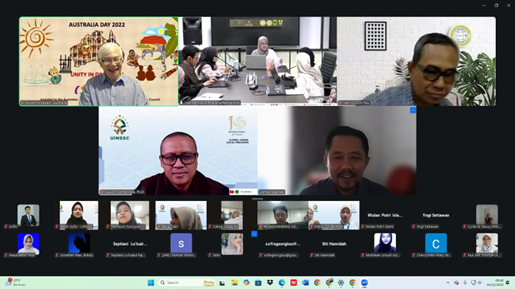
Cirebon, December 4, 2025— The International Office of UIN Siber Syekh Nurjati Cirebon successfully held the final day of the International Seminar and Workshops 2025 with the theme “Returning to the Circle: A Regenerative Pathway Beyond Technocratic Sustainable Development Goals,” conducted in a hybrid setting at the International Office,5th floor of the Cyber Building. The session was attended by the Director of the International Office, Lala Bumela Sudimantara, Ph.D., along with virtual speakers Prof. Rudolf Wirawan (Adelaide University, Australia) and Luqman Baehaqi, Ph.D.(UIN Palangka Raya), as well as Ivan Chabibillah, M.Li. (International Cultural Communication Center, Malaysia) and members of the Global Engagement Team. The second keynote session was by Luqman Baehaqi, Ph.D., moderated by Cahya Salsabilla from the Global Engagement Team. Opening his talk, Luqman stated,“My presentation is inspired by the BIMA framework by Prof. Rudolf Wirawan. I found that BIMA is really interesting, spiritual, and applicable to many aspects of knowledge, in this case, from the perspective of English Language Teaching.” His keynote, titled “Beyond Linear Teaching: A Circular, Multisensory Approach to ELT for a Regenerative Future,” aimed to initiate a paradigm shift in how English Language Teaching (ELT) is conceptualized in a rapidly changing global landscape.
Luqman began by addressing the limitations of traditional ELT, which he argued remains overly linear, target-based, and structured around predictable outcomes. He explained that standard ELT models operate as though learning moves in a straight, measurable line, when in reality language development is cyclical, relational, and deeply connected to human experience. According to him, linear frameworks assume that language can be broken into isolated components such as grammar, vocabulary, and speaking, despite the fact that learners naturally acquire language through interconnected experiences. He emphasized that this approach can distance students from the emotional, social, and embodied dimensions of learning. Luqman also highlighted that over-standardization often erases local identities, replacing meaningful learning with exam-oriented pressures. Thus, rethinking ELT is not merely about methodology, but about rebuilding a model aligned with how humans truly learn in natural, lived contexts.
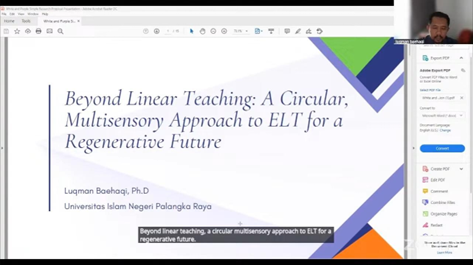
Building on this critique, the keynote elaborated on what Luqman called the Regenerative Alternative, a paradigm that embraces learning as a recurring, emergent, contextual, relational, and regenerative process. He argued that circular learning does not seek to accelerate outcomes for efficiency, but to restore meaningful engagement between learners, their senses, and their environment. This approach positions learning as an evolving spiral: students begin with experience, move into reflection, extract meaning, shift into application, and return to re-experience with deeper understanding. Luqman emphasized that such a model nurtures curiosity, creativity, and emotional presence. Rather than treating language as a set of rules to be mastered, regenerative ELT acknowledges learning as a dynamic process that brings life back into the classroom, strengthening relationships and identity formation.
To illustrate how circularity and regeneration appear in practice, Luqman presented a series of concrete multisensory activities. “Sensory Story Circles” invited students to sit in a circle, interact with sensory objects, and collaboratively build a story, activating imagination and emotional connection. “Spiral Vocabulary Learning” encouraged learners to revisit vocabulary through repeated cycles of discovery, description, application, expansion, and reconnection, ensuring long-term retention. “Walking Dialogues,” conducted outdoors, allowed pairs of students to converse naturally while moving, reducing anxiety and enhancing authenticity. He also introduced Multisensory CALL, integrating sound, images, gestures, virtual reality, and AI-powered pronunciation tools to show how technology can support embodied learning rather than replace it. Together, these examples demonstrated that multisensory, regenerative ELT mirrors how humans communicate in real life through the body, emotions, and social relationships.
Luqman then contrasted Linear vs. Circular Learning, explaining that traditional systems focus heavily on test scores, KPIs, and efficiency metrics, often creating stress and narrowing the learning experience. Circular learning, by contrast, prioritizes renewal, balance, contextual understanding, relational growth, and meaningful engagement. He emphasized that ELT should not be reduced to the teaching of skills, but recognized as a living space for presence, creativity, and transformation. In his closing slide, “Returning to the Circle,” he reminded the audience that “Learning is a circle, each return brings deeper meaning,” a message aligning with the broader conference theme of regeneration beyond technocratic approaches. Through this framework, teachers are encouraged to serve not only as instructors but as facilitators of identity, connection, and lifelong learning.
Despite being held in a hybrid format, the session unfolded with high interactivity, as participants actively posed questions, shared experiences, and reflected on their own teaching practices. Many attendees expressed how the circular and multisensory framework resonated with their classroom realities, sparking discussions on the future of ELT in an increasingly digital world. Reflecting on the role of technology. In his closing, Luqman stated, “I read an article suggesting that English teachers might one day be replaced by AI or robots, but still, machines can never surpass human emotions and the depth of human feeling.” This statement reinforced the idea that regenerative ELT deeply values the emotional and embodied aspects of learning. The keynote also served as the culminating session after the first keynote by Prof. Rudolf Wirawan, signaling the peak of the three-day event. The lively exchange demonstrated that even within an online setting, meaningful, relational, and regenerative learning experiences remain not only possible but powerful.
Author: Salsabilla