
Revealing the Hidden Intelligence of Tradition: A Transformative Lecture by Didin Misbahuddin, S.Hum. Uncovers Lutung Kasarung as a Holistic System of Knowledge, Ecology, and Human Experience
Kuningan, May 2, 2026 — A reflective public lecture themed Academic Voices for a Sustainable Earth: Seminar Series on Sustainability and Eco-Theology unfolded in Pasir Batang, Kuningan, West Java, at the foothills of Mount Ciremai, where students were invited to experience a deeper form of learning rooted in culture and nature. The session was led by Didin Mishbahuddin, S.Hum. (archaeologist), who guided participants into understanding Lutung Kasarung beyond its surface as a traditional story. The lecture also featured contributions from Mr. Sukad and Lala Bumela Sudimantara, Ph.D., whose perspectives complemented the overall discussion. Attended by 84 second-semester students, the lecture created an atmosphere that was both intellectually engaging and emotionally resonant. The natural setting contributed to a sense of calmness that allowed ideas to be absorbed more meaningfully. From the beginning, the session felt different from conventional lectures. It encouraged students to not only listen, but also reflect. This environment opened space for a deeper connection between knowledge and lived experience.
As the lecture developed, Didin Mishbahuddin, S.Hum. explained that Lutung Kasarung should be understood as a structured system of knowledge designed by Sundanese ancestors. He emphasized that the story functions as a learning medium, a source of knowledge, and a representation of social life. Rather than being merely entertaining, the narrative carries layers of meaning that are transmitted across generations. These include values, ecological understanding, and practical life knowledge. According to him, traditional societies did not rely solely on written texts, but on memory, experience, and oral transmission. This method allowed knowledge to remain dynamic and adaptable. Through this explanation, participants began to see storytelling as a legitimate form of education.
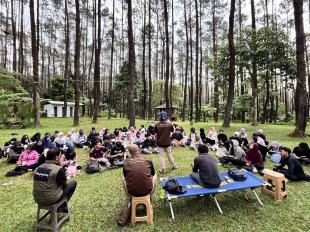
A defining moment of the lecture emerged when Didin Mishbahuddin, S.Hum. highlighted the multilayered structure of carita pantun as a knowledge system. He explained that while people may enjoy the story at a surface level, they simultaneously absorb deeper forms of knowledge without realizing it. As he stated, “Lutung Kasarung is not simply a story—it is a way of teaching life through experience, symbolism, and repetition.” This insight revealed how learning in traditional contexts occurs in subtle and holistic ways. It also challenged modern assumptions that knowledge must always be explicit and structured. Participants responded with curiosity and reflection, recognizing the depth behind what was often considered simple folklore. This moment shifted their perspective on the value of traditional narratives. It became clear that knowledge can be embedded in forms that are both emotional and symbolic.
The lecture further explored how Lutung Kasarung contains practical knowledge, particularly in agriculture and daily life. Didin Mishbahuddin, S.Hum. described the concept of huma (traditional farming) as being encoded within the narrative, functioning as a kind of “manual book” for agricultural practices. Through the story, communities learn about planting, harvesting, and food systems in an indirect yet effective way. This demonstrates how knowledge can be internalized through experience rather than instruction. He also explained that traditional Sundanese education operated through two systems: structured learning in mandala (elite settings) and narrative-based learning for the general public. This dual system reflects a comprehensive approach to education. It integrates both formal and informal methods of learning. The discussion highlighted how education was once closely connected to life itself.
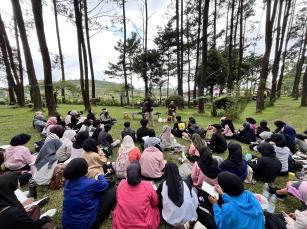
Another important dimension discussed was the transformation of Lutung Kasarung over time. Didin Mishbahuddin, S.Hum. explained that after being documented and adapted into various media, the story gained wider recognition but gradually lost some of its deeper meaning. It shifted from a knowledge system into what is often perceived as mere romantic folklore. This transformation reflects the broader impact of modernization on traditional knowledge. At the same time, he emphasized that the story still holds valuable insights, particularly as an ecological and geological archive. Natural elements within the narrative represent real environmental conditions and historical landscapes. This shows that ancestral communities encoded knowledge about nature into symbolic forms. The lecture encouraged participants to reconsider how tradition is interpreted in modern contexts. It raised awareness about the importance of preserving meaning, not just form.
In its closing reflection, the lecture emphasized that Lutung Kasarung represents a holistic system of knowledge that integrates intellect, experience, and ecological awareness. Didin Mishbahuddin reaffirmed that traditional knowledge should be understood as a living system, not a static cultural artifact. As he concluded, “When we reduce tradition to mere stories, we lose the knowledge that once guided human life.” This statement captured the emotional and intellectual depth of the session. It left participants with a renewed appreciation for the complexity of ancestral wisdom. The experience encouraged them to reflect on how knowledge is defined and valued today. Ultimately, the lecture became a reminder that meaningful learning lies in the connection between humans, culture, and the natural world.
Author: Salsabilla