
Strengthening Indonesia’s Global Presence through Education, Language, Culture, and UNESCO Engagement
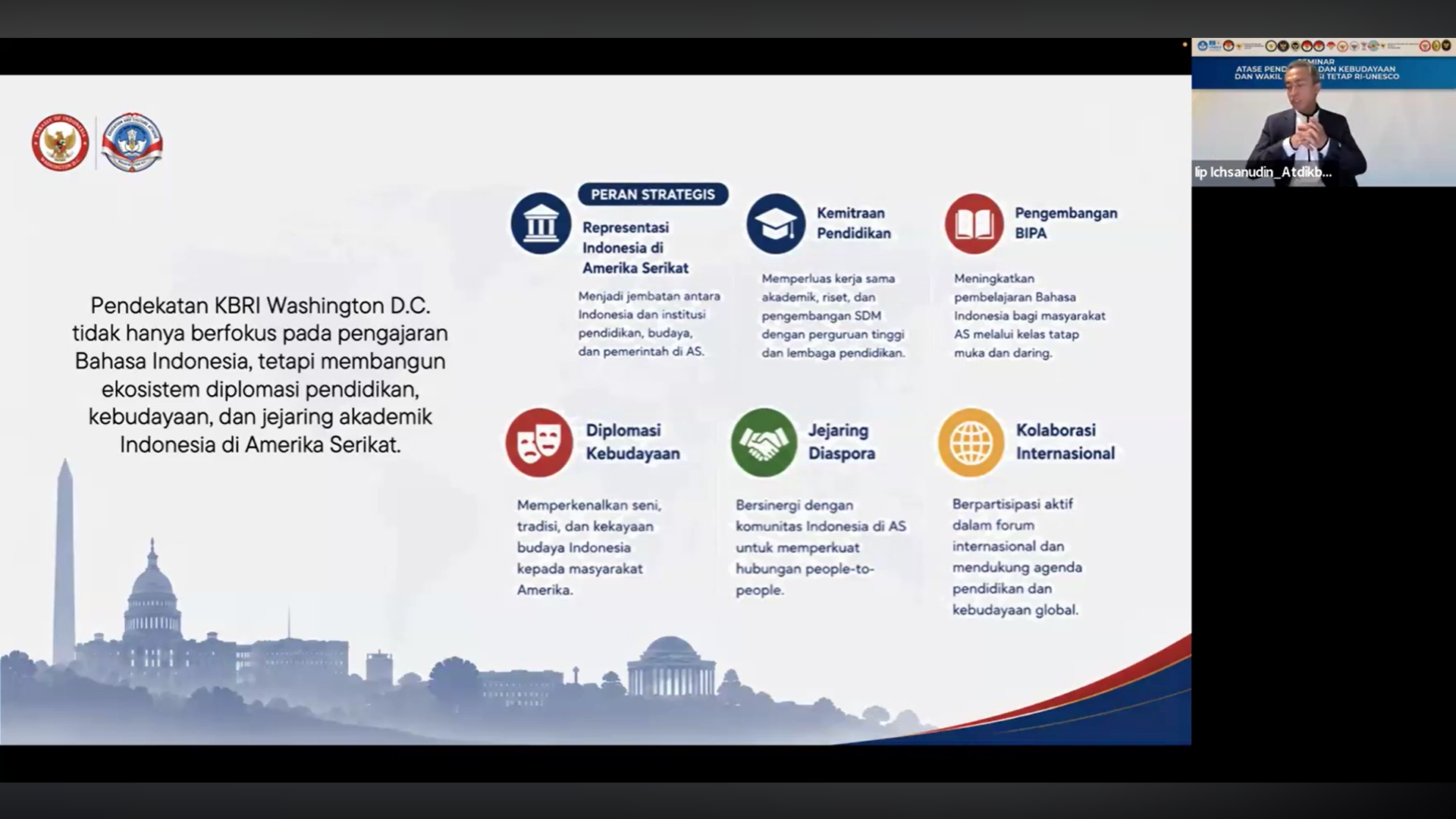
Cirebon, August 08, 2026 – The session of the Seminar of the Education and Cultural Attachés and the Deputy Permanent Delegate of the Republic of Indonesia to UNESCO presented a broad perspective on how Indonesia can strengthen its global presence through the interconnected fields of education, language, culture, international cooperation, and UNESCO engagement. One of the presentations was delivered by Dr. Iip Ichsanudin, S.S., M.A., representing the Embassy of the Republic of Indonesia in Washington, D.C., who highlighted the development of an educational and cultural diplomacy ecosystem in the United States, while the UNESCO-focused presentations introduced the wider international mechanisms available for advancing Indonesia’s cultural assets and initiatives. Across the three presentations, Indonesia was portrayed not merely as a country seeking international recognition, but as a nation possessing substantial linguistic, cultural, intellectual, creative, and heritage resources that can be strategically connected to global networks. In the United States, this approach is reflected in the development of Bahasa Indonesia as an instrument of people-to-people diplomacy, while at the UNESCO level it is reflected through Indonesia’s participation in international heritage frameworks, cultural networks, prizes, fellowships, and funding mechanisms. The overall discussion consequently placed education and culture at the center of Indonesia’s international engagement, demonstrating that the country’s global presence can be strengthened when language, cultural expression, academic collaboration, heritage protection, and international recognition are developed as mutually reinforcing dimensions of diplomacy.
The presentations also revealed that transforming these resources into sustainable international influence is not without challenges. In the United States, the development of Bahasa Indonesia requires more than simply offering language classes; it requires the creation of an ecosystem capable of sustaining learner participation, strengthening academic networks, and connecting language education with broader cultural understanding. The Washington, D.C. presentation consequently emphasizes the importance of moving from merely counting participants to understanding participants, while the Spring 2026 BIPA program recorded a 74.2 percent retention rate, indicating both meaningful participation and the continuing need to understand learners’ journeys. At the UNESCO level, another challenge emerges from the complexity of international mechanisms themselves. UNESCO is not a general funding institution in which every individual or organization can freely submit proposals. Grants, fellowships, prizes, and convention-based assistance each have distinct purposes, eligibility requirements, application pathways, and nomination procedures. Some opportunities are accessible to individuals, others are restricted to legally established organizations or government institutions, while several require endorsement or nomination from recognized bodies. This means that possessing a strong cultural or educational initiative does not automatically translate into international support; applicants must understand the institutional architecture surrounding each opportunity and demonstrate that their work corresponds with the relevant UNESCO mandate.

In response to these challenges, the presentations emphasize the importance of building relationships rather than relying on isolated programs. In Washington, D.C., Bahasa Indonesia bagi Penutur Asing (BIPA) functions not only as a language-learning program but also as a means of developing cultural understanding, expanding academic networks, and strengthening people-to-people relations between Indonesia and the United States. The same principle is reflected in the Indonesia Connect initiative, which brings together students, diaspora communities, academics, and strategic partners through a long-term platform rather than a single event. At the UNESCO level, cultural engagement similarly depends upon collaboration among governments, public institutions, NGOs, universities, communities, cultural practitioners, and international partners. The International Fund for Cultural Diversity (IFCD), for example, supports systemic development in cultural policy, institutional capacity, creative industries, research, advocacy, and cultural networks, while the Intangible Cultural Heritage Fund emphasizes community involvement, long-term benefits, local capacity, inventory, safeguarding, and international cooperation. These mechanisms demonstrate that meaningful cultural diplomacy is inherently collaborative: cultural heritage cannot be sustainably protected without communities, educational initiatives cannot flourish without institutions, and international cultural projects cannot generate lasting impact without networks connecting local actors with global opportunities.
The scale of Indonesia’s cultural and educational resources becomes increasingly visible when examined through the UNESCO frameworks presented during the session. Indonesia already possesses an extensive international heritage profile, including Borobudur, Prambanan, Sangiran, the Cultural Landscape of Bali Province and its Subak system, the Ombilin Coal Mining Heritage of Sawahlunto, and the Cosmological Axis of Yogyakarta as World Cultural Heritage, alongside natural heritage such as Komodo National Park, Ujung Kulon, Lorentz, and the Tropical Rainforest Heritage of Sumatra. Indonesia’s intangible cultural heritage portfolio likewise includes Pantun, Reog Ponorogo, Kebaya, Jamu wellness culture, Gamelan, Pencak Silat, Pinisi, Saman, Angklung, Batik, Wayang, and Indonesian Kris, while nominations such as the Culture of Tempe and Teater Mak Yong are being processed. Indonesia has also developed a growing presence within the UNESCO Creative Cities Network, including Pekalongan, Bandung, Ambon, Jakarta, Surakarta, Malang, and Ponorogo. Beyond recognition, UNESCO mechanisms provide practical pathways for further development: the IFCD can provide up to USD 100,000 for eligible cultural-development projects over 12–24 months, while World Heritage and Intangible Cultural Heritage mechanisms support conservation, safeguarding, research, training, inventory, nomination preparation, and emergency assistance. These opportunities demonstrate that international recognition is not an endpoint; it can become a platform for continued cultural preservation, institutional strengthening, capacity development, and international collaboration.
The presentations ultimately point toward a more strategic model of Indonesian diplomacy in which existing achievements are connected with mechanisms capable of sustaining and expanding their impact. The UNESCO materials show that Indonesia can utilize different pathways according to the nature of an initiative: the IFCD for systemic cultural-sector development, the World Heritage Fund for the protection and management of World Heritage sites, and the Intangible Cultural Heritage Fund for safeguarding living cultural traditions. Beyond UNESCO funding, the presentation also introduces Dana Indonesiaraya, which provides support for international cultural interaction and the international distribution of Indonesian cultural works, including funding ranging from Rp10–50 million for cultural delegations and Rp200 million–Rp2.5 billion for international distribution of cultural works, subject to the stated requirements. UNESCO prizes and fellowships provide another dimension of international engagement, offering recognition and opportunities across education, science, culture, social sciences, humanities, and other fields. Importantly, the presentations emphasize that international opportunities are not necessarily limited to financial assistance. They can generate international recognition, publications, conferences, networks, mentorship, training, research residencies, travel opportunities, seed funding, and technical assistance. The strategic task for Indonesian institutions, therefore, is to align the right initiative with the right international mechanism, prepare credible evidence of impact, fulfill eligibility and nomination requirements, and build partnerships capable of sustaining the work beyond a single funding cycle or diplomatic event.
Within the Seminar of the Education and Cultural Attachés and the Deputy Permanent Delegate of the Republic of Indonesia to UNESCO convey a unified message: Indonesia’s strongest form of international diplomacy emerges when education, language, culture, heritage, creativity, and human relationships are transformed into sustained global connections. The experience of the Embassy of the Republic of Indonesia in Washington, D.C. demonstrates how language education and cultural programming can build people-to-people relationships, while the UNESCO presentations demonstrate how Indonesia can protect, develop, recognize, and internationalize its cultural resources through global frameworks and strategic opportunities. The lesson is therefore not simply that Indonesia possesses abundant cultural heritage or that UNESCO provides grants and prizes; rather, the greater significance lies in Indonesia’s capacity to connect its existing strengths with international networks in ways that produce lasting educational, cultural, social, and diplomatic value. As the Washington presentation concludes, “Diplomasi yang paling kuat bukan hanya diplomasi antarnegara, tetapi diplomasi antarmanusia.” Within the broader seminar, this principle becomes especially significant because the work of the Education and Cultural Attachés and the Deputy Permanent Delegate of the Republic of Indonesia to UNESCO is ultimately about creating the conditions through which Indonesia can be understood, experienced, respected, and connected with communities beyond its borders. Whether through a BIPA classroom, a cultural heritage safeguarding program, a UNESCO Creative City, an international research opportunity, or a cultural project reaching an overseas audience, each initiative contributes to the same larger objective: transforming Indonesia’s educational and cultural wealth into enduring bridges of mutual understanding and international cooperation.