Strengthening Indonesia’s Language and Cultural Diplomacy in Australia and Vanuatu
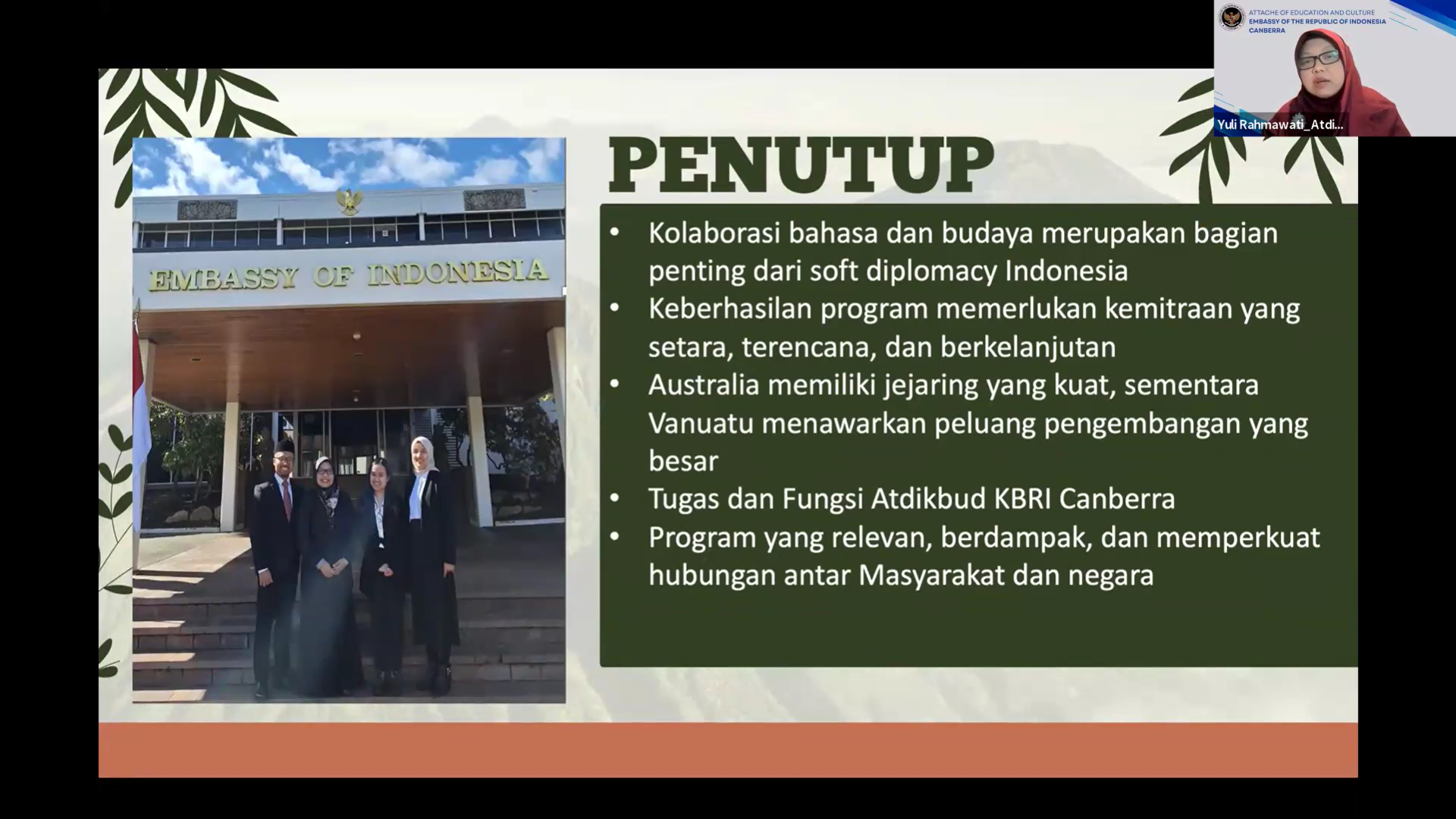
Cirebon, August 07, 2026 – The session of the Seminar of the Education and Cultural Attachés and the Deputy Permanent Delegate of the Republic of Indonesia to UNESCO provided a comprehensive examination of Indonesia’s language and cultural diplomacy in Australia and Vanuatu, particularly highlighting the strategic role of education, language learning, cultural exchange, and people-to-people engagement in strengthening Indonesia’s international presence. The session featured Yuli Rahmawati, the Education and Cultural Attaché of the Embassy of the Republic of Indonesia in Canberra, who presented the development, challenges, and opportunities surrounding Indonesian language and cultural diplomacy in both countries. Her presentation emphasized that Bahasa Indonesia should not be promoted merely as a foreign language to be mastered, but as a gateway through which international communities can encounter Indonesian society, identity, and culture. As Rahmawati stated, “When Australians learn Indonesian, they do not only learn how to speak to Indonesia. They learn how to understand Indonesia.” This perspective frames language education as an important component of diplomacy because it enables learners to move beyond linguistic competence towards intercultural understanding while creating sustained educational and social connections between Indonesia and international communities.
The presentation also highlighted the challenges confronting the sustainability of Indonesian language learning in Australia. Bahasa Indonesia is currently taught across schools, universities, community programs, and BIPA initiatives, yet maintaining learners’ interest remains an important concern. The presentation records 127,649 students at the secondary level and 101,349 students at the primary level, while the number of universities offering Indonesian declined from 22 institutions in 1992 to 12 institutions in 2022. These developments demonstrate that the challenge is not simply the availability of Indonesian language instruction, but the continued ability to establish its relevance within an increasingly dynamic educational landscape. The declining number of university programs, in particular, raises concerns about the long-term visibility of Indonesian within Australian higher education and the opportunities available for students who wish to pursue Indonesian language and Indonesian Studies at an advanced level. Maintaining interest therefore requires Indonesian language diplomacy to respond to changing educational priorities by demonstrating how Bahasa Indonesia can contribute to intercultural competence, academic development, future professional opportunities, and meaningful engagement with Indonesia. Without such relevance, the presence of Indonesian language programs may become increasingly vulnerable despite the substantial foundation that has already been established.

Responding to these challenges, Indonesia has developed a range of initiatives that bring language learning into direct contact with people, institutions, and communities. The programs presented during the session include Community BIPA Online, the Australian Congress for Indonesian Language, School Visits to the Embassy, Indonesian Goes to School, Indonesian Teaching Assistant (ITA), Indonesian Language Teaching Assistant (ILTA), Culture and Language Talks, Indonesian Film Festival, teaching resources, and student awards. Among these initiatives, the ITA program provides direct support for Indonesian language learning in Australian schools and universities through the placement of Indonesian students or lecturers. Between 2023 and 2026, the program involved 138 teaching assistants from Indonesian universities, while the ILTA program in 2026 involved Indonesian students studying in the Australian Capital Territory and placed them in schools including Chapman Primary School, Lyneham High School, Curtin Primary School, and Majura Primary School. These programs establish spaces for reciprocal interaction: Australian learners encounter Indonesian educators and speakers directly, while Indonesian participants gain experience within Australian educational environments. Such encounters make language learning more experiential and interpersonal, allowing Bahasa Indonesia to function not merely as an academic subject but as a medium through which learners can communicate, exchange perspectives, and develop a more immediate understanding of Indonesia and its people.
The language initiatives are further strengthened through scholarship networks and cultural diplomacy, expanding Indonesia’s engagement beyond formal language classrooms. The Indonesian Language Learning Ambassador (ILLA) program, supported by Australia Awards Indonesia, involves Indonesian scholars pursuing Master’s and PhD programs at Australian universities and provides an additional network for Indonesian language engagement. The presentation notes that more than 300 Indonesian Australia Awards scholars are in Australia at any given time, creating considerable potential for educational and intercultural interaction. In Vanuatu, Indonesian language learning similarly contributes to strengthening educational, cultural, and interpersonal relations. During 2025–2026, 22 Vanuatuan students received scholarships from the Indonesian Government through the KNB and TIAS programs, while Bahasa Indonesia is taught through BIPA to help students prepare for academic study and everyday life in Indonesia. Alongside language programs, Indonesia promotes its cultural heritage through art, music, film, culinary traditions, literature, workshops, festivals, and digital media. Initiatives such as the National Folk Festival, Windows to the World, and the Cultural Immersion Program (CIP) 2026 allow international participants to encounter Indonesian traditions, arts, history, and community life through direct and participatory experiences. The combination of language education and cultural engagement consequently creates a broader environment in which Indonesia can be encountered through both intellectual learning and lived experience.
The range of initiatives presented by Rahmawati points towards a collaborative model in which the sustainability of Indonesian language and cultural diplomacy depends upon the active participation of multiple stakeholders. The Atase Pendidikan dan Kebudayaan plays a facilitating role by connecting Indonesian diplomatic institutions with schools, universities, organizations, artists, educators, students, and local communities, rather than assuming responsibility for initiating and implementing every activity independently. Such collaboration must also be supported by careful institutional planning, particularly because activities in Australia and Vanuatu must comply with regulations concerning permits, child protection, visas, insurance, and copyright. The presentation also acknowledges limitations in funding and personnel available to the Atdikbud, making partnerships and shared responsibilities essential for maintaining program continuity. The future development of Indonesian language and cultural diplomacy therefore requires initiatives that are not merely numerous, but relevant, well-coordinated, sustainable, and capable of generating meaningful outcomes for partner communities. By integrating language, culture, education, and community participation, Indonesia can strengthen the existing networks in Australia while simultaneously taking advantage of the considerable opportunities for further development in Vanuatu.
Ultimately, the discussion presented through the Seminar of the Education and Cultural Attachés and the Deputy Permanent Delegate of the Republic of Indonesia to UNESCO illustrates a broader principle of Indonesia’s international engagement: education and culture become most powerful diplomatically when they create genuine opportunities for people to understand one another. The experience of Australia and Vanuatu demonstrates that language diplomacy is not simply about increasing the number of people who can speak Bahasa Indonesia, while cultural diplomacy is not merely about showcasing Indonesian traditions abroad. Both are processes through which Indonesia can cultivate familiarity, trust, reciprocity, and sustained relationships with international communities. As the presentation concludes, “Kolaborasi bahasa dan budaya merupakan bagian penting dari soft diplomacy Indonesia,” while successful programs require partnerships that are equal, planned, relevant, impactful, and sustainable. Within the broader seminar, the case presented by Rahmawati therefore contributes to a shared understanding of the responsibility carried by Indonesia’s Education and Cultural Attachés and the Deputy Permanent Delegate to UNESCO: to transform Indonesia’s educational and cultural resources into meaningful international connections. When language becomes a pathway to understanding and culture becomes a space for genuine encounter, diplomacy moves beyond formal representation and becomes a sustained human process—one capable of strengthening mutual respect, deepening international cooperation, and ensuring that Indonesia’s relationship with the wider world is built not only through institutions, but through people.