
Syarifuddin, S.S., Provides an Expansive Justice-Based Framework for Understanding Ecological Harm, Ecocentrism, and Environmental Rights at the IO UIN SSC International Seminar and Workshop, Challenging the Moral Assumptions Behind the SDGs
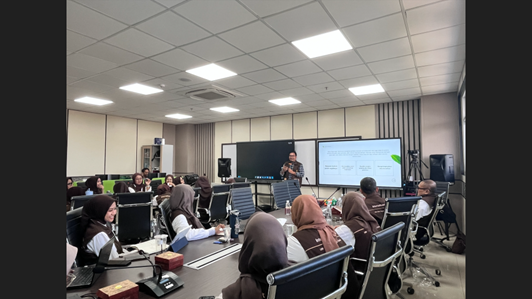
Cirebon, December, 3rd 2025 — International Office UIN Siber Syekh Nurjati Cirebon successfully concluded its three-day International Seminar and Workshop under the theme Returning to the Circle: A Regenerative Pathway Beyond Technocratic Sustainable Development Goals. Guided under the leadership of Lala Bumela, Ph.D., Director of the International Office UIN SSC, the event achieved an exceptional synthesis of ecological, ethical, and epistemological insight. This prestigious program gathered a distinguished constellation of speakers: Rudolf Wirawan, Ph.D. from the University of Adelaide, Australia; Ivan Chabibilah, S.S., M.Li. from ICCCM Malaysia; Luqman Baehaqi, Ph.D. from UIN Palangkaraya; Syarifuddin, S.S., a Civil Servant at the Protocol and Leadership Communication Department of the Regional Secretariat of Cirebon City; Didin Misbahuddin, S.Hum., researcher at Niskala Institute Bandung; and Ukad, Spiritual Elder and Guardian of Sagarahiang Kuningan. Representatives from Hakim Ventural International, namely Aries Endri Susanto, S.T., M.E. and Nur’aeni, S.E., M.E., were also present, while members of the IO’s student internship program, the Global Engagement Team (GET), ensured seamless operations both onstage and backstage. On the second day, Syarifuddin, S.S. delivered his compelling presentation titled “Dosa Ekologis Kita: Bagaimana Etika Lingkungan Mencegah Kegagalan SDGs?” in which he challenged the overly technocratic orientation of the SDGs and argued for an ecocentric, justice-anchored recalibration of environmental governance. Reflecting on the human costs often reduced to numbers, he emphasized, “When people die as mere statistics, we must ask ourselves whether we are truly safe—or merely unaware of our vulnerability.”
The session unfolded with a deep interrogation of the moral fractures embedded within contemporary development practices, illuminating how ecological degradation persists not merely because of technical shortcomings, but because of ethical failures at the societal and institutional levels. With clarity and urgency, the discussion mapped a crisis of empathy occurring within decision-making bodies that remain detached from the lived realities of the communities they serve. The speaker foregrounded that while the SDGs consistently refer to environmental well-being—from food security to sustainable cities—their implementation often betrays an anthropocentric mindset that marginalizes nature as a passive object rather than a relational partner. By tracing the evolution of environmental ethics—from deontology to teleology to virtue ethics—he articulated how a higher ethical consciousness must emerge from within, requiring citizens and policymakers to transcend self-preservation and embrace intergenerational responsibility.
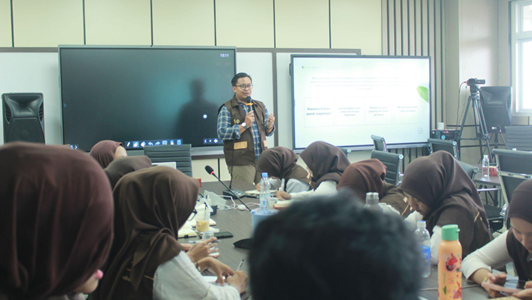
During the interactive dialogue, Syarifuddin, S.S. invited participants to reconsider the very foundations of their relationship with nature, challenging the default assumption that humans hold central priority in ecological decision-making. He positioned environmental ethics as a conversation—a relational act that binds humans to the intrinsic value of the natural world. With reference to the three dominant ethical standpoints—anthropocentrism, biocentrism, and ecocentrism—he urged participants to adopt a justice-based standpoint capable of balancing human welfare, ecological boundaries, and the moral standing of non-human entities. Addressing the room with gravity, he stated, “Justice cannot be partial—not when both humans and ecosystems bear the cost of every decision we make.” His reasoning illuminated why situated knowledge derived from lived experience must coexist with scientific analysis if environmental policies are to achieve true legitimacy.
The discourse grew richer as Syarifuddin expanded on the complexities of applying justice in real-world ecological dilemmas, illustrating how environmental, economic, and cultural systems intersect in ways that demand nuanced ethical discernment. Through evocative case studies—including the story of Slilit Sang Kiai, which demonstrates how even the smallest unauthorized extraction from nature carries profound moral consequences—he illustrated that environmental harm is never merely technical; it is deeply personal, social, and spiritual. He connected this narrative to Indonesia’s ecological paradox: a nation situated on the world’s greatest geothermal belt, rich with natural abundance, yet struggling to reconcile ecological stewardship with economic necessity. The audience was guided to recognize that environmental exploitation is often entangled with the livelihoods of workers whose economic vulnerabilities must also be ethically protected. In this multidimensional landscape, justice becomes not a simple ideal, but an active, disciplined practice.
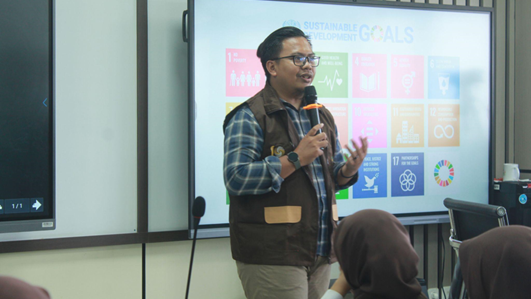
As the session reached its resolution, Syarifuddin, S.S. articulated a powerful framework for reconciling ecological protection with equitable development—a framework grounded in long-term thinking, intergenerational accountability, and a refusal to treat nature as collateral damage. He revisited the landmark argument of Christopher D. Stone, who questioned whether trees should be granted legal standing, to illustrate how law and morality must evolve together in response to ecological crises. Syarifuddin urged decision-makers to adopt a justice-based lens that evaluates not only the immediate beneficiaries of development, but also the ecosystems and unseen communities that bear its hidden costs. He concluded this segment by stating, “Equity demands that we consider both the worker who cuts the tree and the forest that sustains life; justice lives in the space where both are protected without sacrificing one for the other.”
The moral arc of the seminar crystallized in a call for transformative ethical consciousness—one that positions humans not as rulers of the Earth but as stewards within an interconnected continuum of life. In emphasizing that ecological issues are deeply personal yet inseparable from broader social realities, Syarifuddin reminded the audience that no society can thrive while ignoring the ecosystems that sustain its existence. He urged all attendees, especially those entrusted with leadership, to embrace an ethical paradigm that unites scientific knowledge, situated experience, and justice-based reasoning into a single, coherent moral compass. In closing, his words resonated with profound urgency: “If we fail to center justice in our ecological decisions today, we will inherit a future where both humanity and nature stand equally impoverished.” This message served as a solemn yet empowering reminder that environmental stewardship is not merely a policy choice, but a moral obligation shaping the destiny of generations yet to come.
Author: Muhammad Azkiya Bahtsulkhoir