
The Algorithm of Emotion: Resa Diah Gayatri’s AI-Enhanced Evaluation of Affective Content and Critical Reading in Indonesia’s Merdeka Curriculum, Presented at the Pre-Conference AsiaCALL 2025
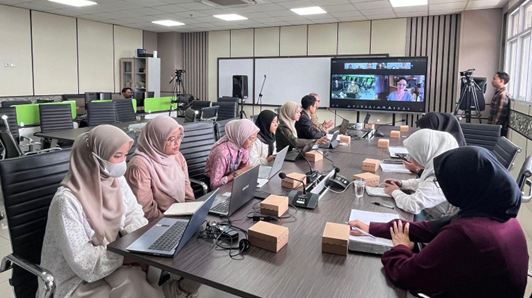
Cirebon, October, 11th 2025 — The pre-conference workshop of AsiaCALL 2025, hosted by the International Office and Partnership of UIN Siber Syekh Nurjati Cirebon under the leadership of Lala Bumela, Ph.D., became a platform where young scholars merged innovation with insight. The capacity-building event was designed to train students who will later present their full papers at the upcoming international AsiaCALL 2025 conference. Among the distinguished researcher was Emma L. Schuberg, Ph.D. from Charles Darwin University, Australia, who provided critical feedback on each presentation. The session featured seven student presenters from the Global Engagement Team (GET)—the International Office team of UIN SSC—including Resa Diah Gayatri, captivated the audience with her paper's blend of linguistic analysis, affective theory, and artificial intelligence. As Lala Bumela emphasized, “This is more than academic preparation—it’s an awakening of intellectual and emotional literacy through collaboration between young minds and technology.”
Resa began her presentation by addressing a critical issue that continues to challenge Indonesia’s education system: the persistent gap between the country’s educational ideals and classroom realities. Despite over a dozen curriculum reforms, including the introduction of the Merdeka Curriculum intended to foster autonomy and creativity, national data show low literacy and English proficiency levels—PISA 2022 recorded a reading literacy score of 383, while the EF EPI 2024 placed Indonesia at a proficiency score of 368. “We dream of learners who can think and feel critically,” Resa said, “but our textbooks still speak in neutral tones, rarely touching the emotions that make language alive.” Her remark resonated with the audience, setting the stage for a discussion about how affect—the emotional dimension of learning—has often been neglected in the push for measurable outcomes and exam-oriented instruction.
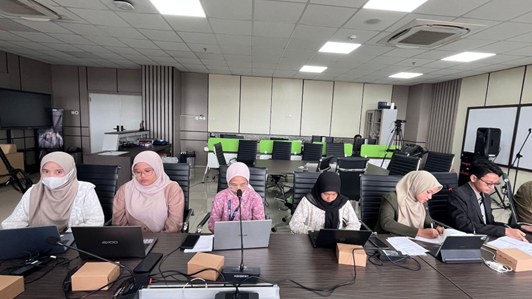
In her dialogue with the researcher and peers, Resa explained that her study explored the affective and aesthetic dimensions of English language learning materials in the Merdeka Curriculum through the framework of Reading for Emotion and Aesthetics (RfEA), developed by Ania Lian (2017). The framework divides emotional engagement into six narrative stages—Focus, Disturbance, Dialogue, Development, Resolution, and Moral—while also integrating aesthetic principles such as Peak Shift, Contrast, and Perceptual Grouping from neuroaesthetic theory. Guided by this model, Resa analyzed the Little Red Riding Hood narrative in the grade 10 English textbook using AI-assisted thematic content analysis powered by the Qwen model, combining machine interpretation and human reflection. According to Lala Bumela, this study represented a powerful example of how “AI can become a cognitive partner that helps us rediscover emotion in learning, not as distraction, but as a form of higher awareness.”
The findings of Resa’s research revealed that while the analyzed text demonstrated functional narrative coherence, it lacked emotional and aesthetic richness. The emotional progression stopped short after the Disturbance phase, failing to fully develop Dialogue, Development, and Moral stages—core elements for cultivating empathy and deep comprehension. Furthermore, the story did not embody the principles of Menggembirakan (joyful learning) and Berkesadaran (mindful learning) promoted in Indonesia’s Deep Learning Framework. Through visualized AI-enhanced mapping, Resa illustrated how emotional intensity and aesthetic balance could be quantified, showing the “flat” emotional rhythm within the text. This absence, she argued, reflected a larger systemic issue: an overemphasis on linguistic correctness over emotional resonance, leading to disengaged learning. Her work thus questioned the extent to which current materials align with the emancipatory intent of the Merdeka Curriculum.
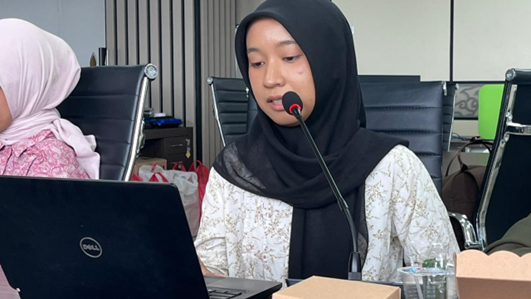
Resa’s research contributed a fresh methodological and philosophical perspective to language education. By combining AI-assisted evaluation with affective textual theory, she demonstrated how technology could act as a reflective tool rather than a replacement for human judgment. “AI,” Resa reflected, “should not replace human understanding—it should expand it. When we let machines read with us, we begin to see emotion not as abstract, but as data that matters.” Her work redefined critical reading as an act of empathy—where cognition and emotion work in tandem to construct meaning. The proposed framework enables teachers to assess not only comprehension but also emotional engagement and aesthetic sensitivity, enriching the interpretive experience for both learners and educators. Through this fusion of neuroscience, pedagogy, and AI, Resa positioned emotional literacy as a central dimension of future-oriented education.
In closing, Lala Bumela, Ph.D. underscored the importance of such student-led research within Indonesia’s evolving academic ecosystem. He remarked that the intersection of emotion, technology, and pedagogy represents “a new intellectual frontier—one where affect meets algorithm, and meaning transcends measurement.” The AsiaCALL 2025 pre-conference workshop thus became more than a preparation event; it became a testament to how young researchers like Resa embody the university’s vision for alternative pathways to knowledge creation. Her presentation stood as an example of transformative literacy, calling educators to rethink not just what is taught, but how it makes students feel, imagine, and become. Through the language of emotion and the lens of AI, her work harmonized science, art, and humanity—an echo of what the future of education might truly sound like.
Author: Muhammad Azkiya Bahtsulkhoir