
The Emotional Semiotics of Heritage: Cyrilla Tsania’s Affective Study on Sundanese Folklore and Critical Reading within Indonesia’s English Language Education at the AsiaCALL 2025 Pre-Conference Workshop
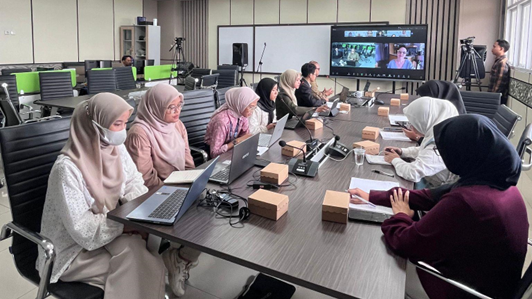
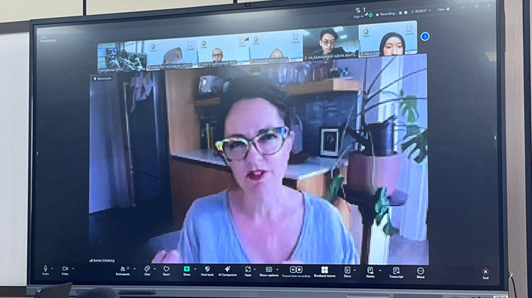
Cirebon, October, 11th 2025 — In the AsiaCALL 2025 pre-conference capacity-building workshop organized by the International Office and Partnership of UIN Siber Syekh Nurjati Cirebon, Indonesia, seven members of the Global Engagement Team (GET) presented their academic papers in front of international researcher Emma L. Schuberg from Charles Darwin University, Australia. The workshop, guided by Lala Bumela, Ph.D., served as both a rehearsal and a scholarly forum for emerging researchers preparing to represent UIN SSC at the AsiaCALL 2025 International Conference. Among the presenters, Cyrilla Tsania Azzahra delivered her thought-provoking study titled “Cultural Heritage Narratives in English Language Teaching in Indonesia: Affective Analysis of Sundanese Folklore for Critical Reading Enhancement.” The paper stood out for its emotional depth and intercultural insight, positioning traditional narratives not as relics of the past but as dynamic pedagogical tools. “This initiative,” said Lala Bumela, “represents how our students are transforming cultural and linguistic heritage into living academic dialogues that connect Indonesia’s soul with the world.”
Cyrilla’s research emerged from her observation of a persistent disconnection between emotion, identity, and literacy in Indonesia’s English language classrooms. Despite ongoing efforts toward quality education under Sustainable Development Goal 4 (SDG 4), much of English Language Teaching (ELT) in Indonesia remains exam-oriented and detached from learners’ emotional and cultural experiences. In her presentation, Cyrilla emphasized that this gap has muted the affective dimension of learning — a dimension that could otherwise foster empathy, curiosity, and cultural awareness. “Students can decode a text,” she remarked, “but they often fail to feel it. When reading loses its emotional pulse, critical thinking also fades.” This insight became her entry point to exploring how Sundanese folklore, when read through affective semiotics, could revive the emotional resonance necessary for deeper comprehension and reflection.
In developing her conceptual framework, Cyrilla bridged semiotics, affective psychology, and literary pedagogy. Drawing upon Charles Sanders Peirce’s semiotic triad, she analyzed folklore symbols not only as linguistic signs but as emotional cues that shape readers’ moral imagination. She also integrated Ania Lian’s “Reading for Emotion” framework, which highlights how emotional engagement enhances critical and reflective reading. Through this synthesis, Cyrilla proposed a model of “Affective Critical Reading,” where students interact with traditional stories through layered interpretation—decoding their signs, sensing their emotions, and reflecting on their cultural meanings. Commenting on her presentation, Lala Bumela noted, “Cyrilla’s work exemplifies how postcolonial narratives and emotional intelligence can reshape English education. It invites us to see language learning not as mastery of form, but as participation in humanity’s shared emotional heritage.”
Methodologically, Cyrilla employed a qualitative content analysis of several selected Sundanese folktales, including narratives rich in symbolic tension—between nature and modernity, obedience and resistance, destiny and choice. Using the lens of affective semiotics, she examined how textual elements such as metaphor, rhythm, and imagery evoke distinct emotional responses among readers. To strengthen her analysis, she integrated AI-assisted emotion mapping to visualize affective shifts throughout the texts, allowing her to observe patterns of empathy, awe, and moral reflection. This hybrid human-AI method, while grounded in traditional humanities research, opened new dimensions in literary pedagogy by revealing how folklore can activate both cognitive and affective circuits in the learner’s mind. The study thus positions heritage narratives as neuro-affective educational resources, capable of awakening a sense of cultural belonging while enhancing critical reading skills in English.
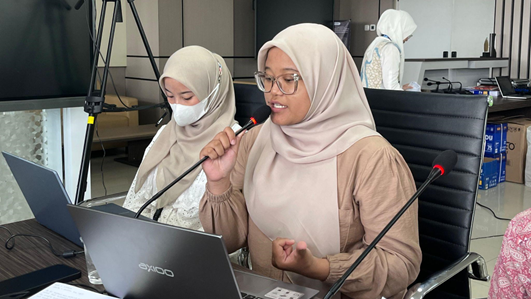
The implications of Cyrilla’s study extend beyond folklore itself—it challenges educators to rethink the role of emotion and heritage in language education. By incorporating affective reading strategies, teachers can foster deeper student engagement and empathy, especially in multilingual, multicultural contexts like Indonesia. Cyrilla’s findings align with the broader movement toward transformative education, emphasizing meaning, ethics, and emotional literacy. “AI and affective analysis don’t distance us from culture,” Cyrilla reflected, “they help us rediscover its pulse—how stories teach us to feel before we learn to argue.” Her statement captured the essence of her study: to humanize critical reading by reconnecting intellect with emotion and tradition with modern learning tools.
Cyrilla Tsania Azzahra’s presentation exemplified the intellectual and cultural mission of UIN SSC—to harmonize faith, intellect, and humanity within global academic discourse. Her affective study on Sundanese folklore offers a blueprint for how language education can nurture empathy through cultural emotion, turning heritage into a medium of emotional intelligence. As the AsiaCALL 2025 conference approaches, her work stands as a symbol of Indonesia’s evolving role in global ELT scholarship—bridging ancestral wisdom with digital innovation. Reflecting on the workshop, Lala Bumela concluded, “Cyrilla’s research shows that heritage is not just something we remember; it’s something we feel and reinterpret for the future. When students learn to read with emotion, they don’t just understand the world—they begin to heal it.”
Author: Muhammad Azkiya Bahtsulkhoir