
The Roots of Tomorrow: IO UIN SSC’s Tree-Planting Project at Sangiang Site Marks a Step Toward Lifelong Global Impact
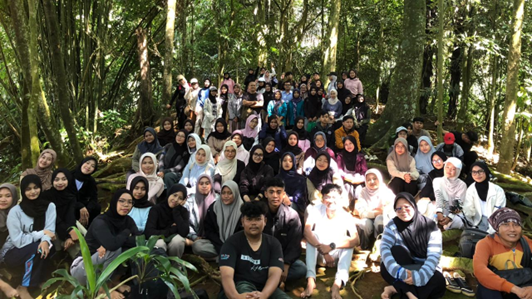
Cirebon, October, 5th 2025 — After exploring the ancestral intellectual legacy and ecological wisdom at Situs Sangiang, Sagarahiang, Kuningan, on Saturday, October 4, 2025, Lala Bumela, Ph.D., the Director of the International Office of UIN Syekh Nurjati Cirebon (UIN SSC), initiated a visionary movement linking education, environment, and global consciousness. Inspired by the ancient harmony between nature and human intellect, he proposed the concept of “lifelong global impact”—a framework of sustainable learning that unites the growth of human knowledge with the preservation of the natural world. “When we walk among the roots of our history, we should also plant new roots for the future,” said Lala Bumela. “Education must not only nurture minds but also heal the planet that sustains those minds.” This statement marked the birth of a significant initiative: the Tree Planting Project by the Global Engagement Team, a team under the International Office of UIN SSC, designed to leave a lifelong ecological footprint through the cultivation of both trees and awareness. The idea was first conceptualized during an online meeting on Sunday, October 5, 2025, where members agreed that education must take physical form in nature itself.
The initiative arises in response to the increasing instability of the global environment, accelerated by globalization and the rapid exploitation of natural resources. The modern world, though advanced in technology, faces a profound disconnect between human intellect and environmental empathy. As Lala Bumela often emphasizes, “global education without ecological awareness is an incomplete education.” Many individuals fail to realize that environmental consciousness is inseparable from mental health, spiritual balance, and biological resilience. This disconnection has led to anxiety, pollution, and unsustainable habits that threaten the continuity of both human and natural life. Hence, the project is not just ecological activism—it is a pedagogical revolution rooted in nature.

“This initiative is the true essence of a transformative educational curriculum,” stated Lala Bumela, Ph.D., in his address to the Global Engagement Team. “It’s not about teaching students what to think, but guiding them to feel and reflect through experience with the earth itself.” He emphasized that sustainability education must transcend theory and emerge through practice, aligning intellectual exploration with ecological restoration.
Members of the Global Engagement Team—Farah Syifa and Cyril Azzahra—shared their excitement during the meeting. “We’ve always learned about sustainability in concepts,” said Farah, “but this time, we’re living it.” Cyril added, “It’s empowering to know that we can contribute to something that connects education, humanity, and environment at once.” Their statements reflect how the initiative cultivates empathy, responsibility, and intellectual maturity—three essential pillars of global citizenship.
The tree planting initiative represents the practical implementation of the BIMA Framework (Bridging Intelligence, Mindfulness, and Awareness), first introduced by Professor Rudolf Wirawan from the University of Adelaide, Australia. The framework emphasizes the integration of cognitive intelligence (the ability to reason and innovate), mindfulness (the awareness of one’s actions and their impact), and awareness (a spiritual and social sensitivity toward life itself). Within the UIN SSC context, the project becomes a living laboratory, allowing students and staff to experience firsthand the interconnection between education and ecology. Each planted tree symbolizes the synthesis of intellect, reflection, and action—a real-world application of the university’s vision for sustainable global engagement.

The Global Engagement Team plans to sustain the initiative as part of UIN SSC’s long-term environmental diplomacy strategy. Collaborations are envisioned with local communities, governmental environmental agencies, and international partners. The project is also expected to inspire cross-university environmental programs within the Southeast Asian higher education network, reinforcing UIN SSC’s commitment to inclusive and sustainable global cooperation. “Planting a tree is not a one-day act,” said Lala Bumela, “it’s a message to the next century—a reminder that education and life must grow together.” Through these symbolic actions, UIN SSC seeks to restore not only the physical environment but also the moral ecology of learning.
In an era defined by acceleration and consumption, this initiative serves as a gentle call to slow down, reflect, and reconnect. It reminds us that the future of education lies not in the separation of science and nature, but in their union. As Lala Bumela concluded, “We educate not merely to compete in the world, but to coexist with it. Every tree we plant is a page in the curriculum of humanity.”The tree planting movement at Sangiang stands as a poetic yet practical symbol of lifelong global impact—where the intellect of the university meets the wisdom of the earth, and together, they write a new chapter for sustainable education.
Author: Muhammad Azkiya Bahtsulkhoir