
Towards the Big Day: AsiaCALL’s Coordinating Teams Finalize Agendas for Pre-Conference Workshops, the Main Event, and Academic Showcases
Cirebon, October, 6th 2025 — Online and offline coordination meetings have been intensively conducted to refine every crucial component of the upcoming AsiaCALL 2025 Conference. The latest online meeting of the International Office and Partnership of UIN Siber Syekh Nurjati Cirebon, held on October 6, 2025, marked a decisive phase where all strategic planning began to reach its final stage. Under the leadership of Lala Bumela, Ph.D. (Director of the International Office and Partnership), the dedicated Global Engagement Team (GET) — comprising Cyril Tsania Azzahra, Resa Diah Gayatri, Tsamara Bahira Alzena, and Muhammad Azkiya Bahtsulkhoir — reviewed the full schedule of pre-conference activities and the main AsiaCALL event. One of the highlighted sessions discussed was the Pre-Conference Workshop scheduled for the second week of October, led by Prof. Andrew Lian, Ph.D. (President of AsiaCALL) and Ania Lian, Ph.D. (Vice President of AsiaCALL), focusing on “AI in Language Education: Between Innovation and Integrity.” This workshop is open to a broad audience of students, teachers, and English lecturers across Asia. “We aim to create a space where innovation and ethical awareness go hand in hand, allowing every participant to reflect on how AI can shape education without losing human integrity,” said Lala Bumela. In total, three major pre-conference events are confirmed, with three additional ones being proposed — including a special workshop designed for students who will present their research at AsiaCALL 2025, helping them refine their performance and confidence before stepping onto the international stage.
Despite having a limited number of personnel, the International Office continues to demonstrate exceptional quality and efficiency in managing its international programs. Each member of the Global Engagement Team works beyond their academic responsibilities, balancing administrative precision with creative problem-solving. The challenge of time management, especially when aligning schedules with international partners from different time zones, has tested the team’s endurance. Yet, their collective commitment remains unwavering. They have streamlined communication channels, integrated task-tracking systems, and maintained consistency with ISO 9001:2015 quality management standards — a remarkable feat for a university that has only recently begun expanding its global engagement. This resilience has become a defining characteristic of UIN SSC’s approach to institutional collaboration and event management.
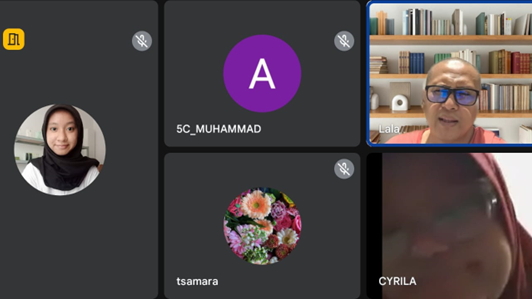
The team’s collaboration is characterized by open discussion, mutual support, and a strong sense of purpose. During the October 6 coordination meeting, Lala Bumela emphasized the value of synchronization between the academic, media, and partnership divisions. He highlighted how essential it is that every aspect of the event — from content preparation to participant communication — is guided by clarity and vision. “Our teamwork is not only about completing tasks,” Lala stated firmly, “but about cultivating a professional ecosystem where everyone learns, leads, and contributes meaningfully to a global cause.” His words resonated with the team, reflecting the International Office’s philosophy that leadership should empower, not merely direct. Under this atmosphere, discussions flowed productively, and innovative solutions emerged organically, ensuring that AsiaCALL’s pre-conference and main conference will run with precision and harmony.
Preparations for the Pre-Conference have now entered their most dynamic phase. The International Office has started running technical rehearsals, simulating the flow of hybrid sessions and fine-tuning both digital and physical setups. The media division is finalizing virtual backdrops, opening sequences, and promotional visuals, while the partnership division is confirming attendance lists and ensuring smooth correspondence with delegates from 14 participating countries. Meanwhile, the academic division is aligning workshop materials and creating opportunities for real-time engagement between keynote speakers and participants. The pre-conference workshops will serve as an academic warm-up — a moment for participants to connect, discuss, and immerse themselves in AsiaCALL’s theme of bridging technology, language, and humanity. UIN SSC’s involvement in this process underscores its growing role as a global hub for digital pedagogy and linguistic innovation.
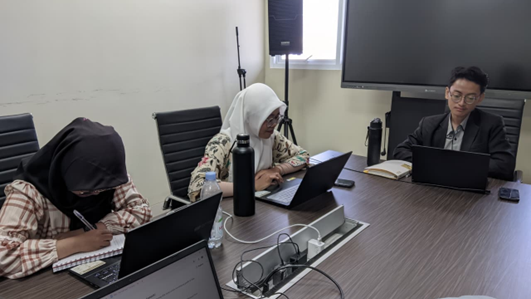
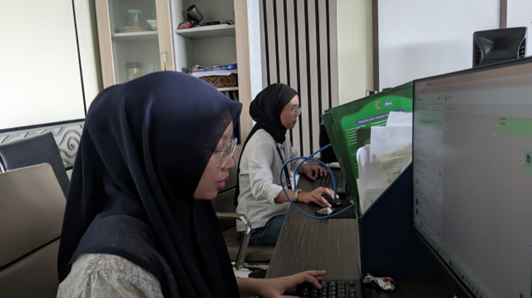
As the conference approaches, UIN SSC’s International Office continues to refine every operational detail, from preparing the moderators’ scripts to setting up the virtual control room that will manage live streaming and recording. The collaboration between students and staff reflects a unique spirit of academic voluntarism, where learning extends beyond classrooms and becomes an act of contribution to global scholarship. AsiaCALL 2025 will not only highlight research and innovation but also serve as a testimony to how collaboration, cultural exchange, and technological literacy can coexist harmoniously. Each pre-conference session, workshop, and cultural presentation will represent a facet of Asia’s linguistic diversity and UIN SSC’s commitment to knowledge diplomacy.
The journey toward AsiaCALL 2025 is more than just an institutional task — it is a collective awakening to the importance of perseverance, professionalism, and global-mindedness in academia. Every member of the International Office embodies these values, transforming challenges into milestones. As Lala Bumela reflected in his closing remarks, “Our preparation for AsiaCALL is not only about organizing an event — it’s about preparing a mindset that is ready for global dialogue and intercultural understanding.” His message captures the moral essence of UIN SSC’s vision: that true internationalization begins within the hearts of those who serve it. Through AsiaCALL, UIN SSC continues to bridge boundaries, reminding the world that meaningful education is built on collaboration, sincerity, and shared intellectual purpose.
Author: Muhammad Azkiya Bahtsulkhoir