
UIN Siber Syekh Nurjati Cirebon Joins Global Education Transformation at ICOE 2026 to Advance Sustainable Digital Learning
Cirebon, September 29, 2026 – The International Office of UIN Siber Syekh Nurjati Cirebon actively participated in The 4th International Conference on Education 2026 hosted by UIN Syekh Wasil Kediri on September 29, 2026. The event was held under the theme "Transforming Education for a Global Impact: Innovation, Digitalisation, and Sustainable Development for Quality Education." This strategic participation aligns with UINSSC's core focus on cyberization and sustainable development. The conference was led by Prof. Dr. Wahidul Anam, Director of UIN Syekh Wasil Kediri, and Prof. Dr. Munifah, Dean of the Faculty of Tarbiyah and Teacher Training. The distinguished keynote speakers included Prof. Icy Lee from Nanyang Technological University Singapore, Dr. Ania Lian from Charles Darwin University Australia, Prof. Ika Lestari Damayanti from Universitas Pendidikan Indonesia, and Dr. Mu'awanah from UIN Syekh Wasil Kediri.
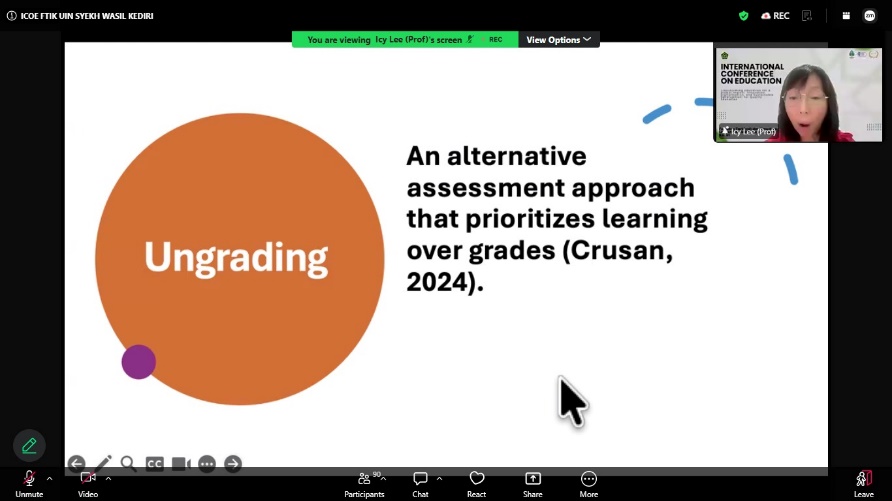
The first plenary session featured Prof. Icy Lee, who presented a compelling case for shifting educational assessment away from traditional grading. She introduced the concept of ungrading, which prioritizes learning over numerical scores by emphasizing detailed feedback and student self-reflection. Prof. Lee argued that grades often undermine intrinsic motivation and that delayed grading allows students to focus on genuine improvement. She stated, "Ungrading is an approach that minimizes grades to support student learning, emphasizing the importance of feedback and self-assessment over assigning scores." This perspective deeply resonated with the UIN SSC team, as it mirrors our institutional push toward regenerative and human-centered pedagogical frameworks. She further explained that when students fixate on scores, they miss the potential for deep learning and risk-taking
A major highlight for the International Office was the keynote address by Dr. Ania Lian, who critically examined the assumptions embedded in digital educational innovations. She warned that generative AI has not only disrupted assessment but also exposed the fragility of the assumptions upon which much of current educational practice depends. Dr. Ania Lian introduced her VIMC framework, which stands for Values, Indicators, Metrics, and Consequences, as a tool to trace how policy values translate into actual student outcomes. She emphasized that without a clear translation from learning processes to consequences, AI will not merely assist learning but will hijack what counts as learning. Her presentation challenged the audience to ask what values educational reforms are actually protecting and whose capacities are being recognized.
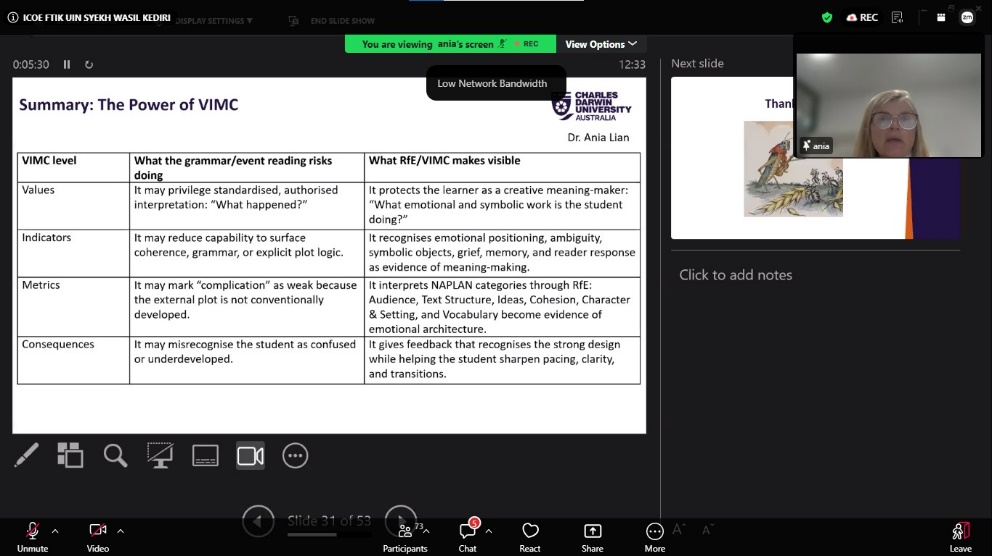
Dr. Ania Lian further elaborated on how her VIMC framework can be applied to ensure ethical AI integration and meaningful assessment. She explained that at the level of values, national policies imagine a specific type of learner, such as a critical participant rather than a compliant performer. At the metrics level, she advocated for traceable judgment instead of fast scoring, ensuring that assessment processes leave a clear record of how students develop their meaning-making skills. She demonstrated the power of her Reading for Emotion model by analyzing a student's narrative text, showing how emotional coherence reveals a student's agency and critical thinking.
Dr. Ania Lian noted, "When we apply emotional coherence to the text, we ensure that the student is able to assert their authority over the audience effectively and transform abstract concepts into something that touches the reader." Her approach provides a robust alternative to standardized testing, perfectly aligning with our vision for multisensory and emotionally engaged language teaching.

The academic discourse continued with Prof. Ika Lestari Damayanti, who explored the concept of literacy as the core of learning across all academic disciplines. She argued that literacy extends far beyond basic reading and writing to include multimodal and disciplinary literacy practices. Using the theoretical lens of Systemic Functional Linguistics, she explained how language varies across different contexts and disciplines, such as mathematics, history, and science. Prof. Damayanti highlighted the importance of genre pedagogy in helping students explicitly see and master these complex language patterns. She stated, "Literacy is not only the responsibility of the language teacher, but every teacher teaches students how knowledge is understood, constructed, and communicated."
The final keynote speaker, Dr. Mu'awanah, addressed the structural side of educational transformation by discussing good university governance. She presented a qualitative case study on integrating academic quality assurance with adaptive institutional policies in the face of rapid technological change. Dr. Mu'awanah emphasized that quality assurance must be a continuous process involving all parties within the university, from leadership to students and support staff. She explained that governance standards must be continually improved to maintain institutional resilience and global competitiveness. Her presentation provided a practical blueprint for how universities can balance rigid quality standards with the flexibility needed for innovation.
The participation in ICOE 2026 marks another significant milestone in our journey to position our students as highly competitive global citizens. Through strategic partnerships and active participation in global forums, UINSSC continues to prove that world-class education can be successfully integrated with our unique cultural and ecological values.