
UIN Siber Syekh Nurjati Cirebon Showcases Global Academic Excellence as Luqman Baehaqi, Ph.D. Highlights a Transformative Multisensory Approach at AsiaCALL International Conference 2025 Day 2
Cirebon, November 16, 2025 — The Second day of the 22nd AsiaCALL International Conference 2025 brought together an impressive assembly of distinguished participants and keynote speakers, led by Lala Bumela Sudimantara, Ph.D., Director of the International Office UIN Siber Syekh Nurjati Cirebon and President of AsiaCALL 2025, who served as a distinguished keynote speaker, followed by Luqman Baehaqi, Ph.D., as the session’s keynote speaker, and accompanied by Ivo Dinasta Yanuar, S.S., M.Appling, Secretary of the International Office and moderator of the session. The conference was further enriched by leading international academic figures, including Prof. Dr. Andrew Lian, President of AsiaCALL; Ania Lian, Ph.D., Vice President of AsiaCALL; Assoc. Prof. Dr. Pham Vu Phi Ho, Vice President for Administrative Affairs and Publication of AsiaCALL; and Prof. Dr. Jeremy White, Vice President for International Relations of AsiaCALL, all serving as executive keynote speakers. Additionally, National and regional scholars such as Prof. Dr. Hj. Ria Yulia Gloria, M.Pd., representing the Rector of UIN Siber Syekh Nurjati Cirebon, Sirniawati, M.A., Wulan Rahmatunnisa, M.Pd., Aries Endri Susanto, S.T., M.E., Eka Destarada Sesunan, S.E., Nur'aeni, S.E., M.E., and Listiani Ekawati, M.Hum, along with presenters from Indonesia, Japan, Saudi Arabia, Malaysia, Vietnam, the Netherlands, and the Philippines, further strengthened the academic diversity of the event. Accompanied by Ghina Amaliyah Sholihah, S.Sos, Staff of the International Office. Hundreds of students from the English Language Teaching Department also attended as enthusiastic participants, adding vibrant academic energy to the conference. Among this strong lineup, Luqman Baehaqi, Ph.D. emerged as one of the most spotlighted distinguished keynote speakers, drawing exceptional anticipation from attendees due to his innovative scholarly contributions to writing pedagogy in Indonesia. His participation did not merely add to the conference’s prestige—it became a focal point of intellectual interest, with many participants specifically looking forward to the insights he would bring.
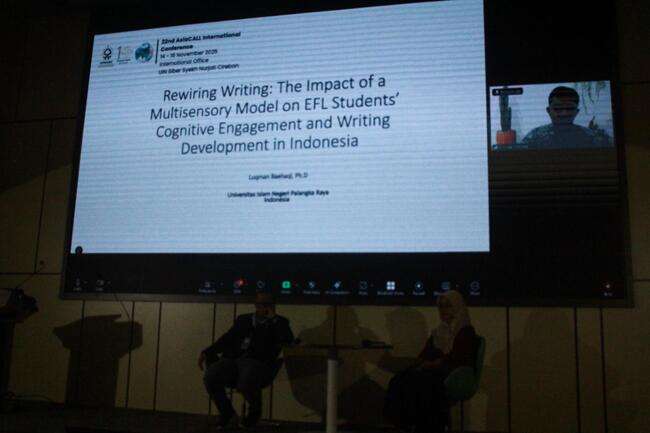
In his keynote session titled “Reimagining EFL Writing through the Multisensory Approach (MSA): A Cognitive–Emotional Framework for Indonesian Learners,” Luqman Baehaqi, Ph.D. delivered a research-driven critique of current English as a Foreign Language (EFL) writing instruction in Indonesia. He explained that traditional form-focused methods and later process-based approaches both improved aspects of writing, yet still failed to fully address deeper cognitive and emotional elements essential for meaningful written expression. According to him, “writing is never merely a mechanical task; it is a cognitive and emotional journey that requires the learner’s whole presence.” His analysis traced how models such as the Genre-Based Approach (GBA), grounded in Systemic Functional Linguistics (SFL), continue to dominate Indonesian classrooms. While these methods strengthen structural awareness, they still leave little room for creativity, imaginative exploration, and authentic emotional engagement.
To respond to these long-standing challenges,Luqman Baehaqi, Ph.D., introduced the Multisensory Approach (MSA), a pedagogical model rooted in cognitive neuroscience and perceptual psychology. This approach emphasises learning that activates multiple sensory channels simultaneously—visual, auditory, kinesthetic, tactile, and emotional. He drew on scientific frameworks such as the Load Reduction Principle and evidence from functional MRI studies to strengthen his argument. These studies demonstrate that multisensory engagement improves attention, emotional regulation, and long-term memory. By integrating these insights, MSA reframes writing instruction as a holistic activity that connects mind, body, and emotion.
Luqman Baehaqi, Ph.D., research was conducted through a 14-week quasi-experimental mixed-methods study involving 69 Indonesian EFL university students. The experimental group received the multisensory curriculum, while the control group continued with the standard GBA method. The multisensory classroom incorporated rhythm-based pronunciation, colour-coded mind maps, gesture-based chunking, and reflective sensory journaling. These activities encouraged students not only to understand writing but to experience it. The contrast with the control group highlighted significant differences in engagement, emotional involvement, and creativity.
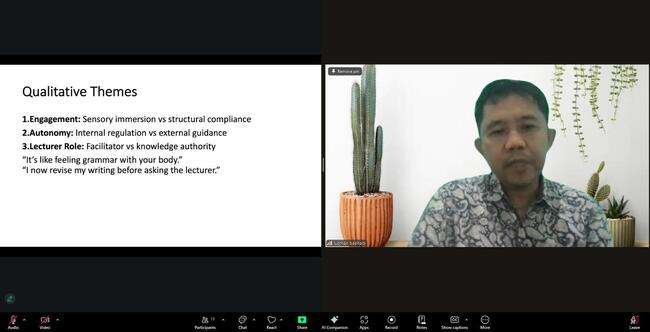
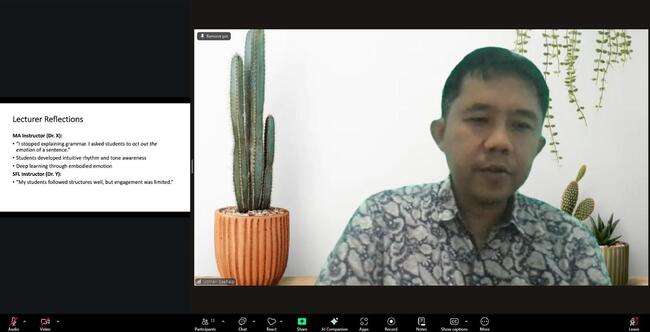
Quantitative findings from the study were striking, showing significant improvement in the MSA group (p < .001), while the GBA control group showed no meaningful change (p = .299). Cognitive engagement and learning satisfaction were also higher among students who experienced multisensory learning. Qualitative analysis revealed themes such as “sensory immersion” and “internal regulation,” suggesting that students became more connected to their writing process. One instructor noted, “I stopped explaining grammar. I asked students to act out the emotion of a sentence,” demonstrating how embodied learning transformed the classroom environment. Meanwhile, GBA instructors reported that while students followed structural conventions, emotional investment remained minimal.
These findings suggest that the Multisensory Approach has the potential to reshape writing pedagogy in Indonesia by integrating cognitive, sensory, and emotional dimensions. The model supports the development of autonomy, intrinsic motivation, and deeper comprehension—qualities rarely fostered in traditional EFL writing contexts. By shifting writing from a memorisation-based task into a meaningful practice of expression, MSA encourages students to think, feel, and create. It also aligns with global trends in education that recognise emotion as a driver of learning rather than a distraction from it. For Indonesia’s EFL landscape, this represents a transformative step forward.
The International Office of UIN Siber Syekh Nurjati Cirebon highlighted that contributions such as Luqman Baehaqi, Ph.D., exemplify the purpose of the AsiaCALL Conference: to bridge innovation, research, and meaningful global collaboration. As the host of the 2025 conference, the International Office underscored its mission to create platforms where scholars from different countries can exchange insights and shape the future of language education. The presence of international keynote speakers and cross-country presenters further enriched this academic event. This collaborative environment reflects the International Office’s vision to position UIN SSC as an active global partner in research and digital education. Through events like AsiaCALL, the institution continues to expand its international footprint.
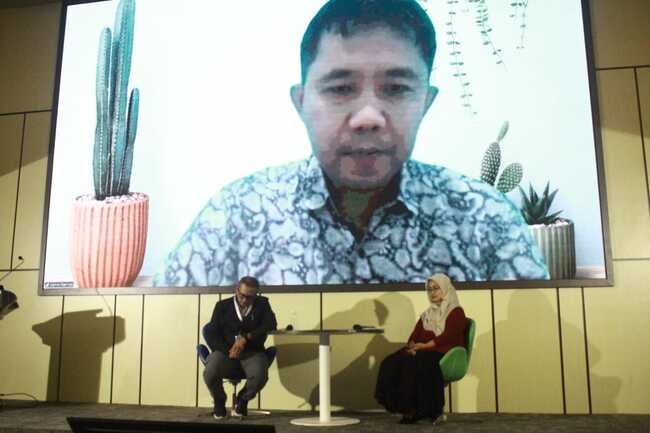
Overall, the presentation by Luqman Baehaqi, Ph.D. stood out as one of the most intellectually engaging sessions of the day. His work not only critiques existing pedagogical limitations but also offers a scientifically grounded solution capable of transforming writing education in Indonesia. Participants praised the clarity, relevance, and forward-thinking nature of his approach. For the International Office, this session reaffirmed the importance of fostering academic dialogue that drives innovation. With such impactful contributions, the AsiaCALL International Conference 2025 successfully showcased the synergy between research, technology, and global scholarly collaboration.
Author Cindi Aulia