
UINSSC English Education Students Capture a Once-in-a-Lifetime Golden Opportunity at AsiaCALL 2025, Engaging with AI-Enhanced CALL, Expanding Global Perspectives, and Advancing Their Expertise in Language Education
Cirebon, November, 16th 2025 — Across three intellectually vibrant days, students of the English Education Department at UIN Siber Syekh Nurjati Cirebon immersed themselves in AsiaCALL 2025, transforming the conference into a living arena of academic exploration. Under the direction of Lala Bumela, Ph.D., Director of the International Office of UINSSC and President of the 22nd AsiaCALL International Conference, the event convened leading voices in CALL and AI-driven pedagogy from across Asia and Australia. Among them were Prof. Dr. Andrew Lian, Ph.D.—President of AsiaCALL and Professor at Suranaree University of Technology (Thailand) and the University of Canberra (Australia); Ania Lian, Ph.D.—Vice President of AsiaCALL and Senior Lecturer at Charles Darwin University (Australia); Assoc. Prof. Dr. Pham Vu Phi Ho, Ph.D.—Vice President for Administrative Affairs and Publication of AsiaCALL, Dean at Industrial University of Ho Chi Minh City (Vietnam); Prof. Dr. Jeremy White—Vice President for International Relations of AsiaCALL and Senior Faculty Member of Ritsumeikan University (Japan); Assoc. Prof. Hassan Khosravi, Ph.D.—Vice President for Administrative Affairs of AsiaCALL and Learning Analytics Specialist at The University of Queensland (Australia); and Prof. Shameem Rafik-Galea, Ph.D.—Professor of Applied Linguistics at SEGi University (Malaysia) and long-standing AsiaCALL Executive Member, and distinguished presenters from Japan, Malaysia, Vietnam, Saudi Arabia, and the Philippines. Throughout the sessions, UINSSC students displayed remarkable intellectual initiative, posing sharp questions that drew direct praise from Lala Bumela, Ph.D., who noted, “Our students entered this space with confidence. They engaged with international scholars as active knowledge-builders, not passive attendees.”
Yet amid the excitement, students quickly encountered the complex realities behind AI-enhanced learning. The presentations made it clear that Artificial Intelligence—while powerful—carries consequences requiring critical attention. Sessions by machine-learning specialists, CALL researchers, and assessment technologists revealed sensitive issues: the erosion of human pedagogical control, the risk of cognitive dependency on automated feedback, and the possibility that future classrooms may be shaped more by algorithms than by educators. These concerns repeatedly surfaced in keynotes delivered by AsiaCALL leaders, sparking internal tension among students who wondered whether the accelerating presence of AI might redefine the very identity of teachers and learners. The disturbance was palpable: they were witnessing a technological revolution strong enough to reshape the foundations of language education.
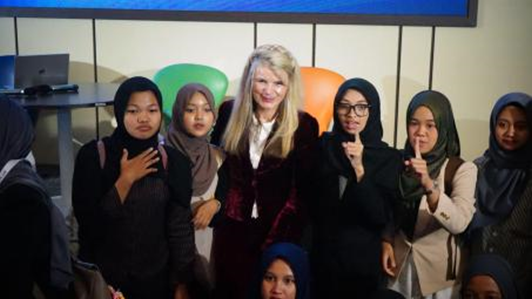
During the dialogue sessions, the students directly engaged with the overarching theme of “AI in Language Education: Opportunities, Challenges, and Future Directions.” Their questions sparked a series of honest, future-oriented conversations with the panel of international scholars. The discussion highlighted that AI opens extraordinary possibilities for personalization, efficiency, and data-informed learning—but also introduces ethical dilemmas, pedagogical risks, and structural uncertainties that must be addressed with care. When students expressed concern over whether AI might eventually overshadow or even replace human teachers, the experts emphasized a unified message: the future of language education depends on a balanced partnership between intelligent technologies and human educators. AI may transform classroom practices, but human judgment, empathy, creativity, and moral responsibility remain irreplaceable. Through this exchange, students gained a clearer understanding that meaningful innovation requires both technological insight and human-centered values—turning their initial anxieties into a more confident, informed outlook on the future of the field.
With each session, the students’ understanding deepened. Workshops led by CALL practitioners, AI-integrated curriculum designers, and multimodal learning specialists exposed them to the intricacies of automated feedback systems, speech-recognition tools, multimodal composition platforms, and AI-powered assessment technologies. Students learned how ethical frameworks are built, how algorithmic biases can shape learner outcomes, and why informed human oversight remains essential. Their questions grew sharper; their reflections, more layered. Observing this transformation, Lala Bumela, Ph.D. expressed admiration: “Our students navigated complex global conversations with maturity. They interacted with experts at professional-level depth. This is the kind of global literacy UINSSC aims to cultivate.”
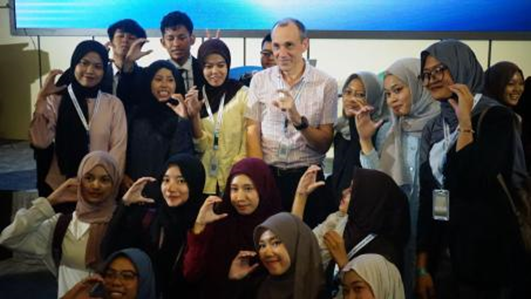
By the closing evening of the conference, the earlier uncertainties had shifted. Students realized that AI is not a threat to their future vision, but a catalyst that demands knowledgeable, ethical, and reflective educators. The concluding sessions—many led by senior AsiaCALL scholars—highlighted that the value of teachers increases, not decreases, in an AI-driven world. The students left with renewed academic clarity: their task is not to compete with technology, but to steer it toward human-centered learning. Equipped with new global insights, expanded academic networks, and a deeper understanding of CALL, they returned to campus with confidence, ready to integrate their new knowledge into both their studies and their vision of future teaching.
AsiaCALL 2025 revealed a powerful moral lesson: no matter how advanced Artificial Intelligence becomes, the core of education remains profoundly human. Curiosity, critical judgment, ethical awareness, and intellectual courage—these are qualities no machine can replace. The experience affirmed that international engagement is not only about gathering information, but about forming character, expanding perspectives, and strengthening the commitment to responsible innovation. As reiterated by Lala Bumela, Ph.D., “Our students didn’t simply attend an international conference—they stepped into the global arena, and they rose to the challenge.” With this experience, UINSSC English Education students are now better prepared to contribute meaningfully to the evolving future of AI-enhanced CALL and language education..
Author: Muhammad Azkiya Bahtsulkhoir