
Walking the Living Archive of Sunda Knowledge: Lala Bumela, Ph.D., Director of the International Office of UIN Siber Syekh Nurjati Cirebon, Guides Dozens of Students in an Ecological, Emotion-Based Creative Writing Curriculum at Mount Ciremai through the Wisdom of Lutung Kasarung
Cirebon, December, 6th 2025 — Amid the lush, undulating slopes of Mount Ciremai, dozens of third-semester students of the English Education (Tadris Bahasa Inggris) Department undertook an extraordinary journey under the guidance of Lala Bumela, Ph.D., Director of the International Office at UIN Siber Syekh Nurjati Cirebon. This expedition was not merely an academic exercise; it was an immersive enactment of ecological, emotion-based creative writing pedagogy, where the boundaries between classroom and landscape dissolved entirely. Traversing the verdant paths of Pasir Batang, students engaged directly with the living heritage of Sunda culture through the multidimensional narrative of Lutung Kasarung. In this context, rice terraces, sacred weaving sites, cascading waterfalls, and oral literatures such as kawih panyawekan transformed into dynamic classrooms, carrying embedded knowledge of cosmology, ecology, and history. Lala Bumela, Ph.D., addressing the group as the sun filtered through the dense forest canopy, remarked, “We are stepping into a living text. Each footfall, each breath of wind, each ripple of water is a sentence in the story of Sunda knowledge. Today, learning is not passive—it is an act of immersion, reflection, and communion with life itself.”
The journey was as demanding as it was enlightening. The students faced steep inclines, rugged terrain, and the unpredictability of natural elements, which mirrored the challenges inherent in deciphering centuries-old knowledge. The rice fields, meticulously terraced along the slopes, were not only scenic but embodied archives of agricultural knowledge, ritual timing, and ecological harmony. Students observed farmers’ planting patterns, leuit (traditional rice barns), and the gestures accompanying rice cultivation—each movement carrying centuries of inherited wisdom. Nearby, sacred looms and intricate tenun patterns narrated the essential role of Sundanese women, particularly figures such as Nyi Purbasari, in preserving collective memory and cultural identity. Oral traditions like kawih panyawekan revealed hidden histories of Mount Ciremai, its springs, shifting landscapes, village origins, and terminologies of surrounding territories. In the face of these rich, layered phenomena, students confronted intellectual and emotional tension: the awe of natural beauty, the challenge of observation, and the responsibility of translating this immersive experience into meaningful creative writing.
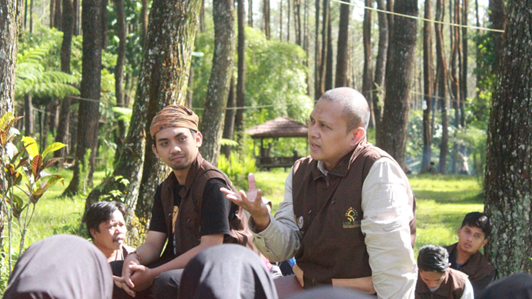
As the hike progressed, conversations naturally emerged among the students, oscillating between curiosity, contemplation, and interpretation. Pausing at a gently flowing spring, students discussed how water rituals, planting chants, and seasonal observances encode ethical relationships with nature. Observing sacred tenun in a shaded grove, they traced the continuity of life, labor, and memory preserved in vibrant patterns, recognizing how these artifacts serve as both archives and living texts. Lala Bumela, Ph.D., halting the group near a cluster of ancient banyan trees, reflected aloud, “These trees, the soil, the terraces, the songs—they speak across centuries. If you learn to listen attentively, they will teach you lessons no textbook can convey. Education is here, embodied in the land, the practices, and the stories that inhabit it.” Students recorded observations, sketched motifs, and transcribed poetic expressions inspired by the environment, translating sensory, emotional, and intellectual experience into narrative form.
The ascent continued, increasingly challenging both physically and mentally. Students were required to integrate mindful observation, ecological literacy, and historical context into their creative expressions. The act of hiking, feeling soil textures, smelling wet moss, listening to birdsong, and observing rice terraces and water flows became a metaphorical conduit for understanding interconnected systems of life. Lala Bumela, Ph.D. emphasized the depth of this engagement, saying, “The mountain is a teacher, the rivers are lecturers, and the tenun patterns are manuscripts. Only through sustained attention, respect, and reflection can you translate this knowledge into words. Creativity is born when observation and empathy meet rigor and discipline.” By integrating multi-sensory engagement, reflective thought, and narrative articulation, students were able to translate experiences into emotionally resonant, ecologically informed, and historically grounded creative writing outputs.
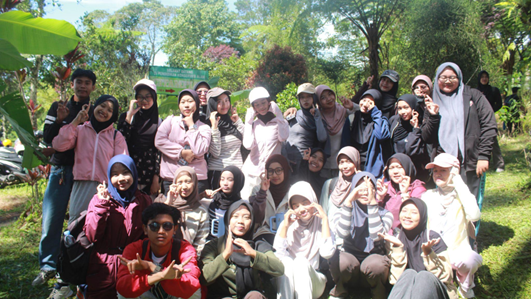
Reaching a panoramic viewpoint in late afternoon, the students experienced a culmination of physical exertion and cognitive revelation. Lala Bumela, Ph.D. gathered the group, inviting them to reflect on the journey as a microcosm of Sunda cosmology and ecological stewardship. The rice terraces, tenun motifs, kawih panyawekan, and oral histories converged into a living archive, illustrating the profound integration of culture, nature, and cognition. As he stated, “You have walked through centuries of memory, through the interplay of human practice and natural rhythm. This is education in its most holistic form—ethical, regenerative, and alive. You are not merely students here; you are witnesses, interpreters, and carriers of knowledge.” Students shared insights, documenting narratives that captured both the visual grandeur and the intangible wisdom of the landscapes and traditions encountered.
At the conclusion of the expedition, Lala Bumela, Ph.D. reflected on the enduring significance of Sunda knowledge as an intellectual and moral compass. Sacred rice fields, intricate tenun guided by ancestral women, and oral literatures like kawih panyawekan were revealed as living archives that record ecological, cosmological, and historical knowledge in perpetuity. By walking, observing, and reflecting, students experienced knowledge as relational, continuous, and regenerative, embracing a spiral of understanding that merges intellectual, emotional, and sensory engagement. Lala Bumela, Ph.D. concluded with a profound exhortation: “This mountain, these terraces, these songs—they are alive. You are not only learning; you are entering a dialogue with ancestors, with nature, and with yourself. Our heritage is a living archive. Walking it is a responsibility, a privilege, and a path to enduring wisdom.”
Author: Muhammad Azkiya Bahtsulkhoir